www.F1scalemodels.com
... specialising in 1:43 scale model cars (Formula 1, Indy 500, Le Mans, GT and classic and modern road cars)
New Additions: December 2025
Hello and welcome to the last update for the year. Thank you to all those who stopped by my stand at the Collector Con on November 23, I hope you enjoyed the day despite the heat inside the halls. I received a shipment of Spark models. A handful of modern Le Mans cars were in the parcel and a couple of models from the same marque, captured my attention.
The Cadillac V-Series.R is a sports prototype car designed by Cadillac and built by Dallara. It was designed to the Le Mans Daytona hybrid (LMDh) regulations which requires the use of a standardised hybrid system, a supplied gearbox, and a chassis from one of four designated manufacturers (Dallara, Ligier, Multimatic, and Oreca). These LMDh cars are designed to be a more cost-controlled alternative to the more open LMH (Le Mans Hypercar) regulations and can compete in both the IMSA GTP class and the FIA World Endurance Championship Hypercar class. Teams can choose their internal combustion engine, but it must run on a specific synthetic fuel. In 2021, Cadillac announced their intention to compete in both the IMSA SportsCar and the FIA World Endurance Championships in 2023 and that Action Express Racing and Chip Ganassi Racing would campaign their cars. Cadillac's return to the 24 Hours of Le Mans in 2023 marked their first appearance in the endurance race in 21 years, having last competed in the 2002. The #2 Chip Ganassi car took a surprising 3rd overall in the race and ran relatively trouble-free, finishing a lap down behind the winning Ferrari and the Toyota. The sister #3 car finished 4th. The two Chip Ganassi Cadillac's have been produced by Spark and would be a welcome addition to any Le Mans collection.
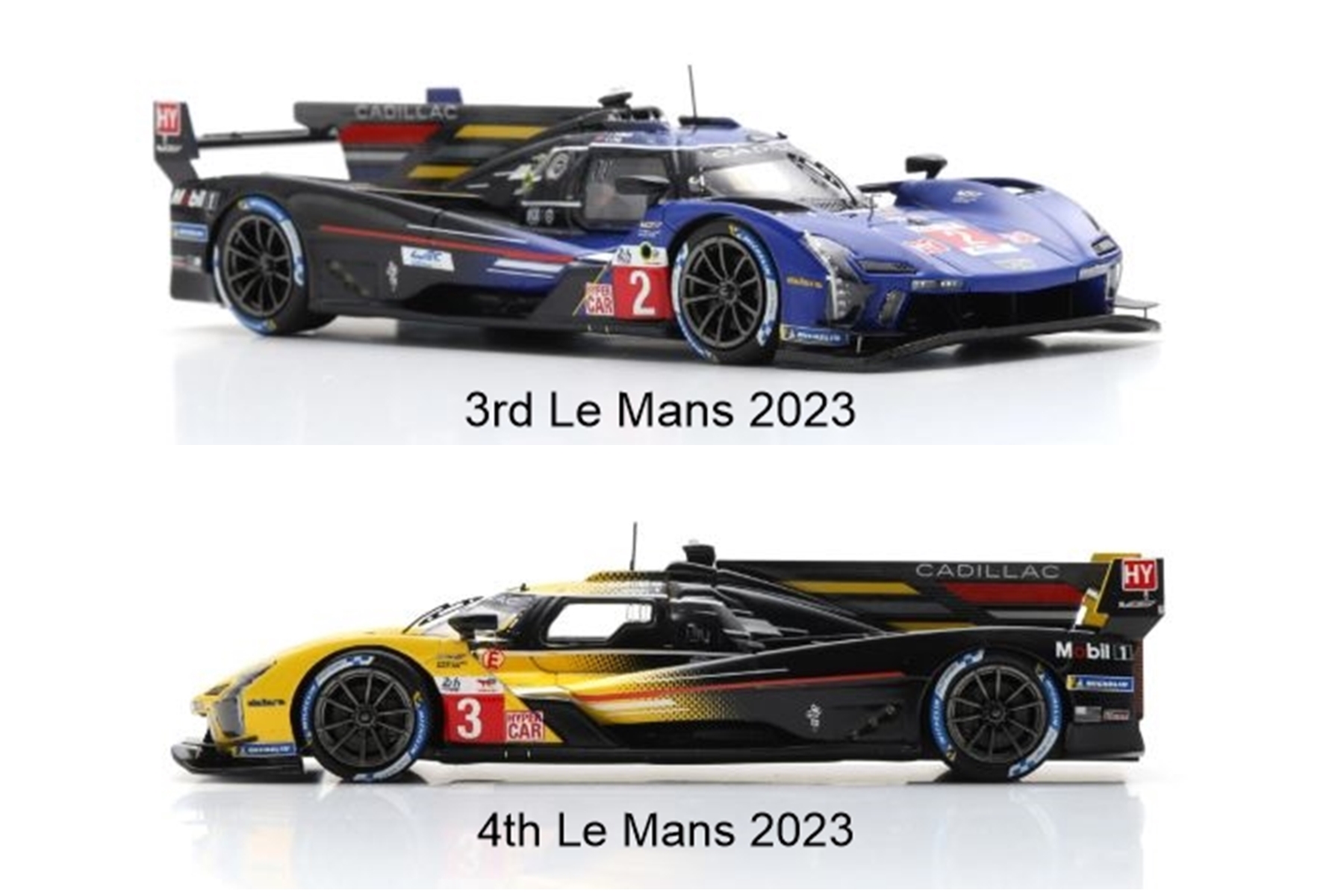 Spark: Cadillac V-Series.R - Le Mans 2023
Ok, that's the last update for 2025 done and dusted. So what's on in December, well not a lot really. Just the regular first Friday Sydney Toy and Hobby Fair on 5 December, which will be your last chance to score yourself a Chrissy present. As usual, it will be held at the Epping Creative Centre, 26 Stanley Road, Epping starting at 6:00pm. Just a heads up, the first Sydney Toy and Hobby Fair for 2026 will be on 2 January. Until next month, have a safe and relaxing time over the festive season and happy collecting.
Formula One
- 2023 Alpha Tauri RBPT AT04, D.Ricciardo (3) 7th Mexican GP (Spark)
- 2023 McLaren Mercedes MCL60, O.Piastri (81) 3rd Japanese GP (Spark)
- 2024 RB RBPT VCARB 01, D.Ricciardo (3) Bahrain GP (Spark)
Le Mans
- 2023 Cadillac V-Series.R, Bamber/Lynn/Westbrook (2) 3rd Le Mans (Spark)
- 2023 Cadillac V-Series.R, Bourdais/Van Der Zande/Dixon (3) 4th Le Mans (Spark)
- 2024 Ford Mustang GT3, Barker/Hardwick/Robichon (77) Le Mans (Spark)
- 2024 Ford Mustang GT3, Roda/Pedersen/Olsen (88) 3rd LMGT3 Le Mans (Spark)
- 2023 Glickenhaus 007, Dumas/Pla/Briscoe (708) 6th Le Mans (Spark)
- 1970 Porsche 911S, Koob/Kremer (47) 7th Le Mans (Spark)
American Racing Series
- 2022 Porsche 911 Hoonipigasus, K.Block (43) Pikes Peak (Spark)
After Thoughts: "A 60-year retrospective - The 1965 F1 World Championship."
Despite the disappointment of the 1964 championship, Jim Clark was optimistic now that he had a more reliable and more powerful Lotus to contest the '65 season. His Lotus 33 was now fitted with a new 32-valve version of the Coventry-Climax engine. The season began on January 1 at the East London circuit in South Africa. Clark started on pole and totally dominated the race, with Surtees (Ferrari) and Hill (BRM) coming in 2nd and 3rd respectively. However, in sixth place, and claiming a point was a young Jackie Stewart (BRM) in his debut race. The young Scotsman had been impressive in F3 and F2 machinery and was tested by several F1 teams but ultimately was signed to race alongside Hill at BRM.
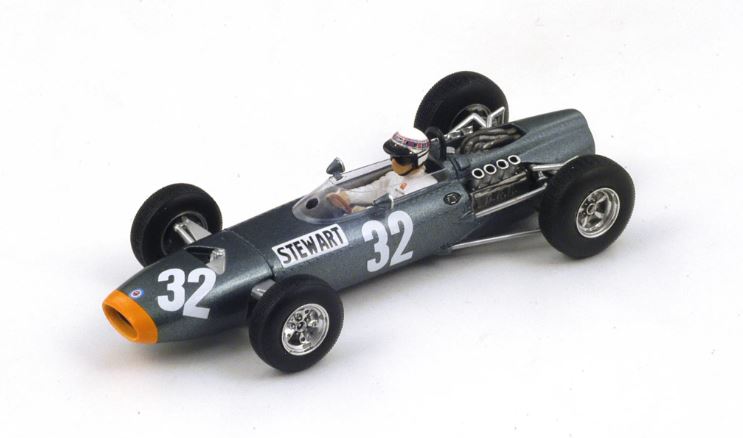 Spark: BRM P261 Jackie Stewart 1965 (S4247)
The second event was Monaco but Clark was away contesting the Indy 500 for Lotus (which he won in record time) and Hill took his third successive win at the principality. In horribly wet conditions at the Belgian GP, Clark led all the way, while Stewart finished 2nd. The two Scottish drivers repeated the performance at the next race in the French GP. Taking 4th place in France, and scoring his first points was another debutant, Denny Hulme (Brabham) of New Zealand. Clark now had a commanding lead in the championship with 27 points, with Hill and Stewart both on 17 points.
Clark won at Silverstone and Zandvoort. The Dutch GP was overshadowed by an incident on the dummy grid when a policeman tried to evict Colin Chapman for not wearing his official armband, which was actually attached to his belt. A scuffle broke out and Chapman threw a punch and he was arrested after the race. He was not released until the Tuesday after the race. Despite the incident, the Dutch race was a comfortable win for Clark but at the British GP, Clark's Lotus had a dramatic loss of oil pressure which threatened his race. But Clark expertly nursed his ailing car home first, closely followed by Hill. The championship standings were now Clark 45 points, Hill 26 points, and Stewart 25 points.
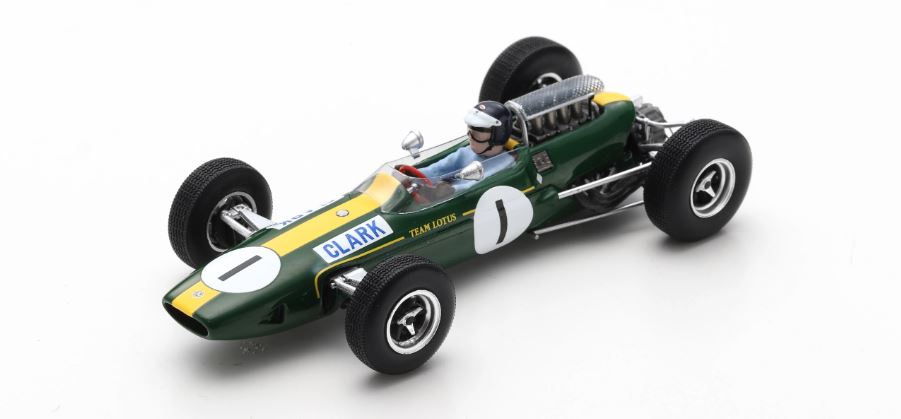 Spark: Lotus 33 Climax Jim Clark 1965 (S1614)
The title was settled at the next race at Nuremberg. Clark's sixth win of the season made his the fastest secured title in the Championship so far. The race was a series of technical disasters for most of the main contenders, for them, the battle was now for the minor positions behind Clark.
Clark was on pole postion at Monza once more but here his winning run came to an end with fuel pump failure. With Clark's retirement, Stewart led a BRM 1-2 to score his maiden GP win. A broken piston ended Clark's race at the penultimate race at Watkins Glen in which Hill scored his second win of the season. Clark recorded another DNF due to engine failure at the last race in Mexico. The Honda RA272, with its V12 suiting the high altitude, qualified third and driver Richie Ginther led from start to finish to score a memorable first win for himself, for Honda and for Goodyear. The final points standing was Clark 54 points, Hill 40 points, and Stewart 33 points.
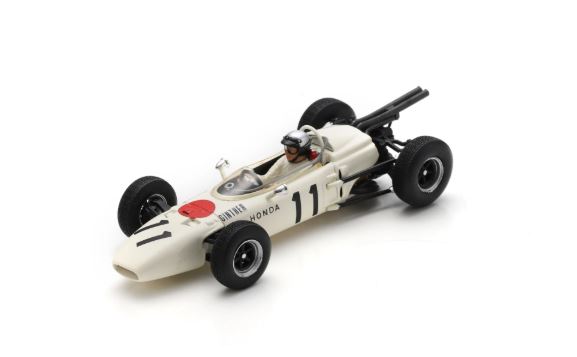 Spark: Honda RA272 Richie Ginther 1965 (S6218)
So great was Clark's superiority that upon his return from the Indy 500, he won the next five races in which he led every lap of those races except for the first five laps of the Dutch GP. He qualified in the top two all season and he also won two non-championship races. The last year of the 1.5-litre Formula, 1965 was ultimately Clark's year. He had established himself as the greatest driver of his generation and his partnership with Colin Chapman and Lotus made him seem invincible.
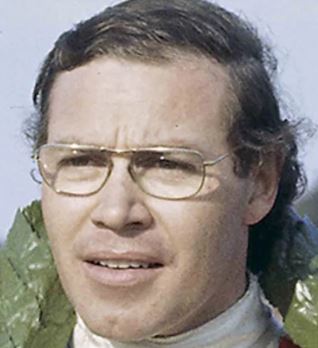 Vale: Allan Moffat Australian Driver. (10/11/39 - 22/11/25)
New Additions: November 2025
Hello and welcome to the November update. This month is all about Ferraris and Looksmart. As I mentioned last month, I was expecting a delivery of some long-awaited Ferrari models from Italian model marker, Looksmart and they have arrived. Bburago have the official licence to produce Ferrari models but some Italian makers have also been granted permission to produce models from the Scuderia, Looksmart is one of them. However, Looksmart's prices are worlds away from Bburago's and some would suggest so are the relative qualities of the products. What I have noticed with some of the new Looksmart models is the packaging. Those familiar with the Looksmart brand would know their 1:43 models usually come hidden inside a red cardboard box, with a lift up top cover. Some of the new models retain this packaging but are now in black boxes and some have a cut-out on the side of the box to reveal the model inside. This is a very welcome change. OK, so which model deserves a special mention?
Ferrari last won the Le Mans 24 hour race in 1965 and so there was much anticipation when the factory entered the 499P in the Hypercar class in 2023. The unveiling of the 499P in 2022 marked 50 years since Ferrari last fielded a factory-backed sports prototype in international endurance racing (the 312P in 1971), and one of the 499Ps raced with the number 50 as a tribute. The 499P was designed under the Le Mans Hypercar regulations, therefore it did not feature the standardised parts such as the ones found in cars designed to the Le Mans Daytona h regulations, however, the chassis was manufactured by Dallara. The name of the car evokes Ferrari's winning past, taking the single-cylinder displacement (499 cc) and using the "P" designation for prototype. The 499P made its competition debut at the 1000km of Sebring in March 2023 and was immediately competitive, taking pole postion with the #50 car and eventually finishing 3rd. The #50 car also took pole position at Le Mans with the sister car #51 in second position but it was the #51 car that led for the last 55 laps to take a famous victory. This Looksmart model is a must for Ferrari collectors and for collectors of Le Mans winners.
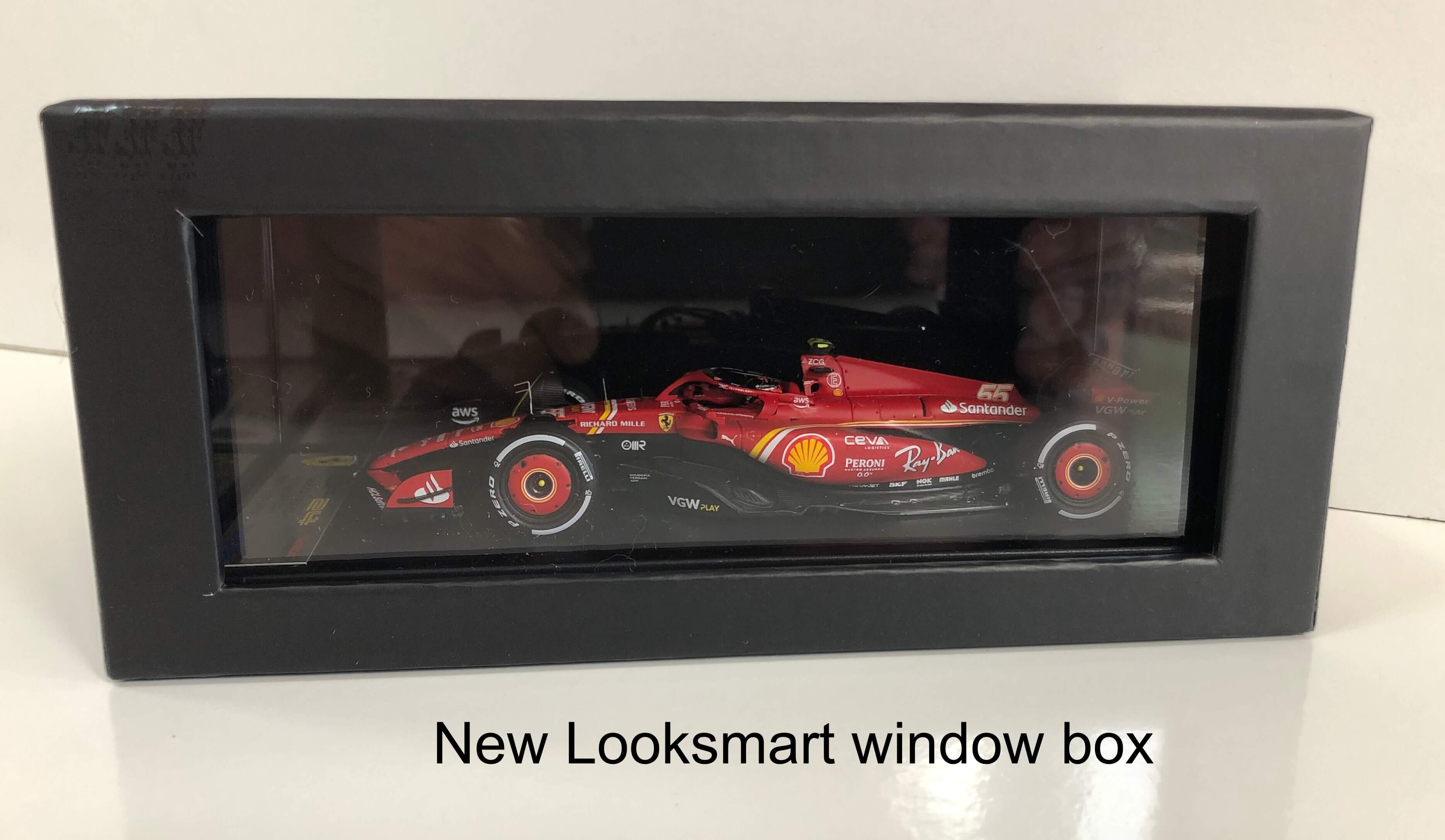 Looksmart new "window" box
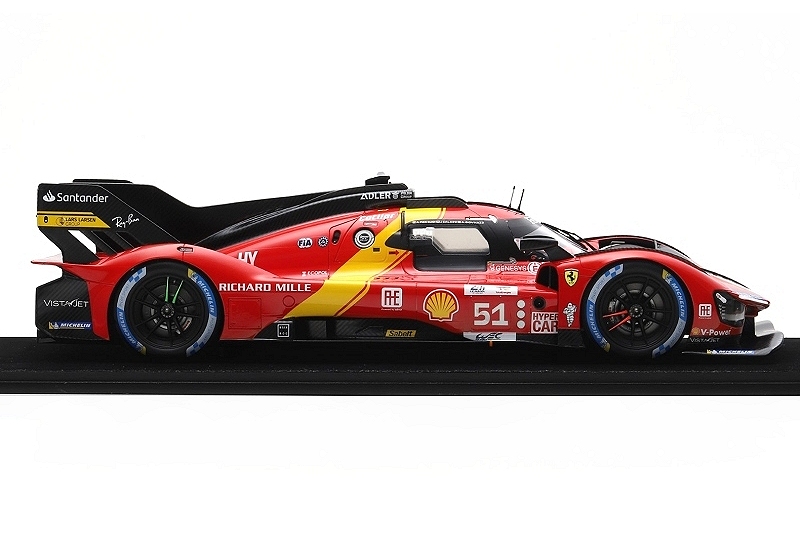 Looksmart: Ferrari 499P 1st Le Mans 2023
Well, that's another monthly update done and dusted, so what's happening in November? The regular Sydney Toy and Hobby Fair is on November 7 at the Epping Creative Centre, 26 Stanley Road, Epping starting at 6:00pm. Then, the Collector Con is on November 23 at the Penrith Valley Regional Sports Centre, 30 Herbert Street, Cambridge Park. Until next month, happy collecting.
Formula One
- 2023 Ferrari SF23, C.Sainz Jr.(55) 3rd Italian GP (Looksmart)
- 2023 Ferrari SF23, C.Sainz Jr.(55) 6th Las Vegas GP (Looksmart)
- 2024 Ferrari SF24, C.Sainz Jr. (55) 1st Australian GP (Looksmart)
- 2024 Ferrari SF24, O.Bearman (38) 7th Saudi Arabian GP (Looksmart)
Le Mans
- 2020 Ferrari 488 GT Modificata, Track day car (Looksmart)
- 2023 Ferrari 488 GTE EVO, Flohr/Castellacci/Rigon (54) Le Mans (Looksmart)
- 2023 Ferrari 296 GT3, Presentation car (Looksmart)
- 2023 Ferrari 499P, WEC Hypercar Presentation car (Looksmart)
- 2023 Ferrari 499P, Pier Guidi/Calado/Giovinazzi (51) 1st Le Mans (Looksmart)
- 2023 Ferrari 499P, Fuoco/Molina/Nielsen (50) 5th Le Mans (Looksmart)
- 2024 Ferrari 499P, Fuoco/Molina/Nielsen (50) 1st Le Mans (Looksmart)
1:18 Model
- 2023 Ferrari 499P, Pier Guidi/Calado/Giovinazzi (51) 1st Le Mans (Looksmart)
After Thoughts: "The Forgotten F1 Circuits #8 - Caesars Palace."
The Caesars Palace Grand Prix of 1981 and 1982 is one of the most unusual chapters in Formula One history — a world championship race held in the car park of a Las Vegas casino.
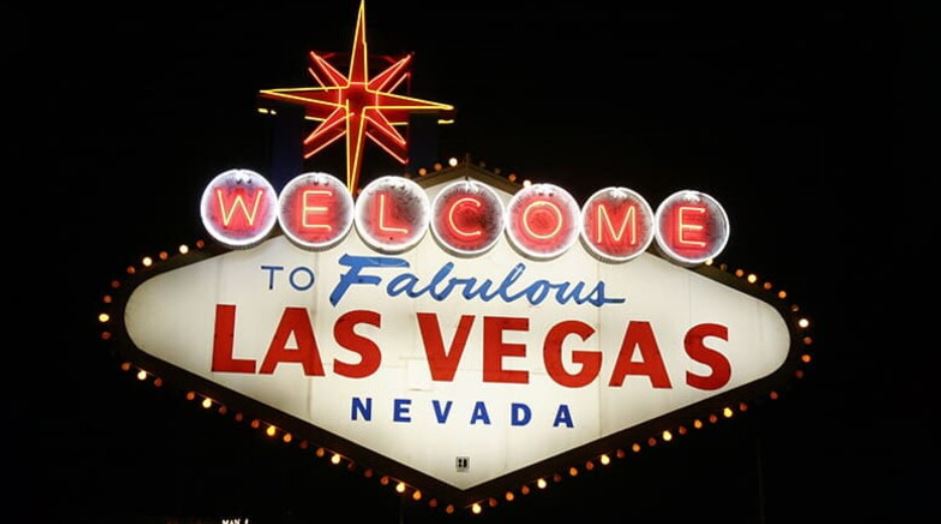
By the early 1980s the rising glamour of Formula One racing, promoted by Bernie Ecclestone, caught the attention of the bosses of Caesars Palace. They conceived the idea of bringing the glamour of Formula One to Las Vegas — combining racing, luxury, and spectacle in the heart of the Strip. Their reasoning was simple; host a world class race and the money would surely come in as high-rolling guests flocked to enjoy the spectacle. Caesars Palace also offered its sprawling car park as the location.
A deal was struck for Las Vegas to feature as the final race of the 1981 season, following a week after the Watkins Glen GP. But when the upstate New York track fell into financial difficulty and failed to pay monies owed to the teams from the 1980 race, it was dropped from the schedule, giving the Caesars Palace event even greater prominence. A temporary 2.268-mile (3.65 km) circuit was laid out in the casino’s parking lot but the opulence of the venue, however, was not matched by the circuit itself. The flat layout was surrounded by concrete barriers and grandstands, creating a tight, technical course, featuring 14 corners and running anti-clockwise. The circuit twisted back-and-forth on itself because of the restricted size of the car park but it did at least offer good views for the spectators, at least for those prepared to brave the Nevada sun to sit in uncovered grandstands.
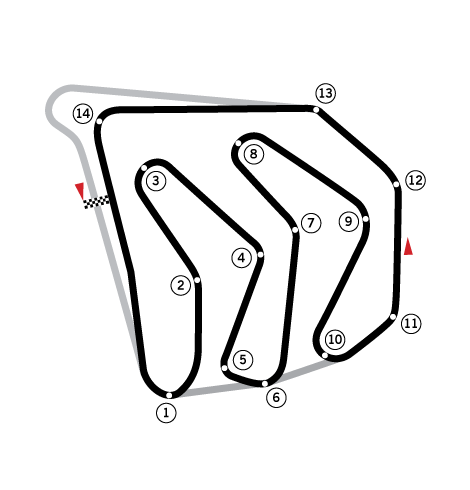 Caesars Palace GP Circuit
The circuit did have some reasonably fast sections bordered by sandy run off areas, but the slow switchbacks proved a repetitive bore. The lack of reference points amid the concrete canyon of walls was always likely to make it tough to find a rhythm, while the beating heat and unusual anti-clockwise layout was punishing for the drivers after a long season. Reigning World Champion Alan Jones was typically forthright at the time, calling it "a goat track flattened out". That probably didn't go down too well with the casino owners.
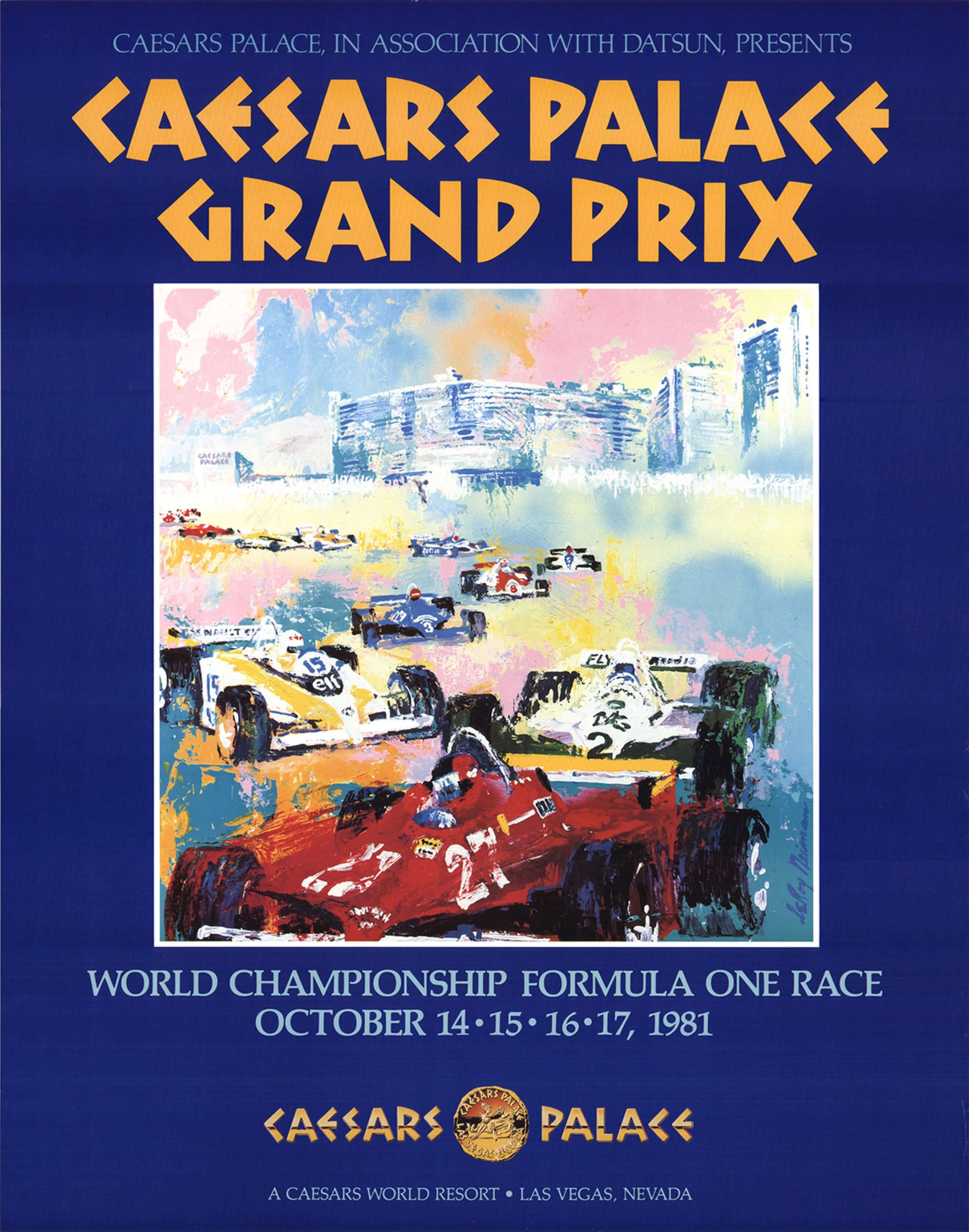 Caesars Palace 1981 Poster
Nevertheless, the sporting prospects looked good. The Formula One circus arrived with the title still to be decided with three drivers in a shoot-out for the ultimate prize. Williams driver Carlos Reutemann headed the championship with Nelson Piquet a point behind for Brabham, with Ligier driver Jacques Laffite an outsider's bet. The race was a little disappointing, even if it did have plenty of drama. Jones, despite his antipathy towards the track, simply cantered off into the distance to score what was to be his 12th and final Grand Prix win. Behind him there was plenty of jostling for position as cars broke, the brutal 40°C heat got to the drivers and fortunes wavered back and forth. With Reutemann failing to finish, Piquet's 5th place was enough for him to be the 1981 World Champion. The effort in the heat proved almost too much for the champion to bear and he needed to be carried from his car at race's end.
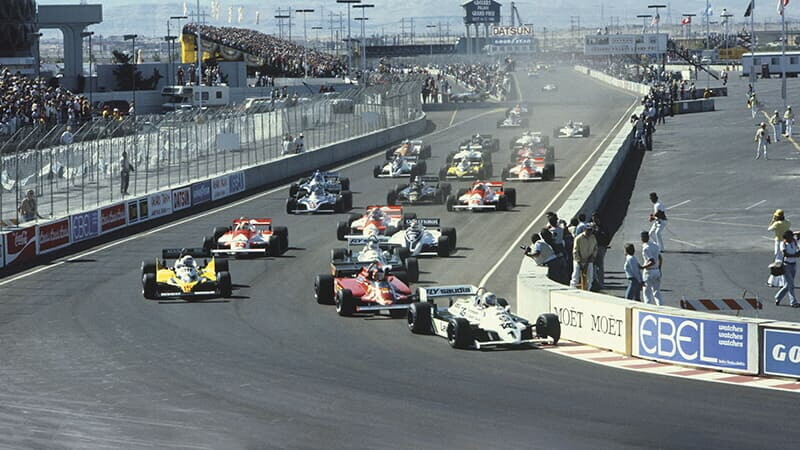 Start of the 1981 Caesars Palace GP
The following year's race threw up another title fight, this time the contenders were Williams driver Keke Rosberg with McLaren's John Watson an outside chance. The race did at least develop some good battles but at the end, Michele Alboreto prevailed in the Cosworth powered Tyrrell and Rosberg's 5th place gave him the championship. However, the crowd numbers were again poor, and the novelty of the GP had clearly worn off.
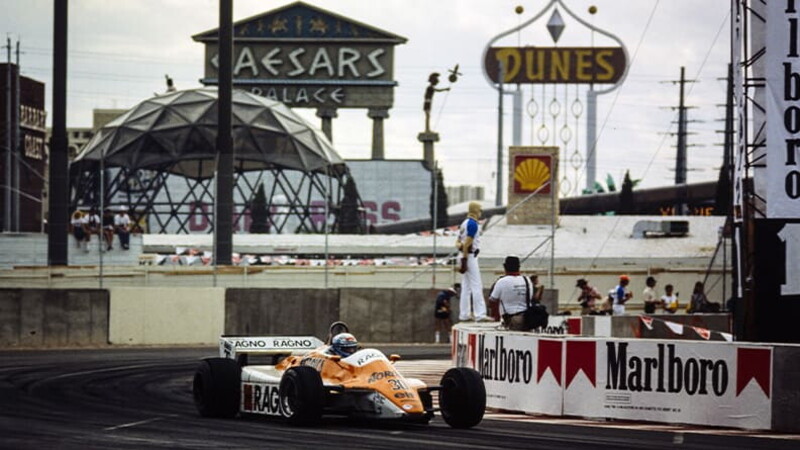 Arrows Cosworth A4 at the 1982 Caesars Palace GP
After two years of poor crowds and with the high rollers not arriving in mass numbers as predicted, the finances didn't look good for the Caesars Palace bosses, so a parting of the ways with F1 was perhaps mutually agreeable. It's fair to say Formula One should never have gone to Vegas. The Caesars Palace circuit was logistically difficult, offered little excitement for spectators, and generated minimal local interest. With poor ticket sales and tepid TV coverage, it was inevitable the venue was dropped after 1982. Still, the Caesars Palace Grand Prix remains a fascinating reminder of Formula One’s ambitious (and sometimes misguided) push into the American market.
New Additions: October 2025
Hi and welcome to the October update. We are really powering towards the finishing line now with just 14 weeks left before we close out the year; where has the year gone? Thank you to all those who dropped by my stand at both the All British Day and the Hawkesbury Model and Hobby Show in September. We had glorious weather for both events, something that's not guaranteed as average rainfall records keep getting broken. It was a very quiet month for model arrivals, with very little to report but this will change as I'm expecting some long-awaited Looksmart models. The expected models include the long awaited Ferrari 499P Le Mans winner from 2023 in both 1:43 and 1:18. Also coming are some 2023 Ferrari F1 models, again from Looksmart. From the meagre offerings this month, there is one model that merits some attention.
The model of the 1952 Ferrari 212 Inter Street by Ghia from BBR is sometimes listed as the personal car of Eva Perón, wife of Argentinian President Juan Perón. However, this is incorrect. The president spotted this Ferrari at the Paris Motor Show in October 1952, about three months after the death from cancer of his beloved wife. Presidente Perón, a noted protector of Nazis dodging war crimes, was also well known for being an automotive enthusiast, collecting everything from Ferraris to Packards during his time in power. He was also a supporter of Argentine drivers Juan Manuel Fangio and José Froilán González, providing monetary backing for their careers. Just a few dozen examples – believed to be 73 – of the Ferrari 212 were made in the early 1950s. It was both an extremely quick road car and a very successful race car, which came in a variety of individually created bodies by several of the great Italian coachbuilders, icluding Ghia and Pininfarina. When Perón was ousted from power in 1955, he fled the country but the car remained in Argentina. It was finally passed on to a dealership in the early 1970s and an Italian collector living in Buenos Aires purchased the car in 1973, driving the one-off car for 14 years. In 1987 it was sold and moved to Europe, where it was sold again in 1999 to a collector of coachbuilt Ferrari cars. That owner continued to keep the car in near-perfect condition and in 2018, the 1952 Ferrari 212 Inter was sold at auction for $1,187,500 USD.
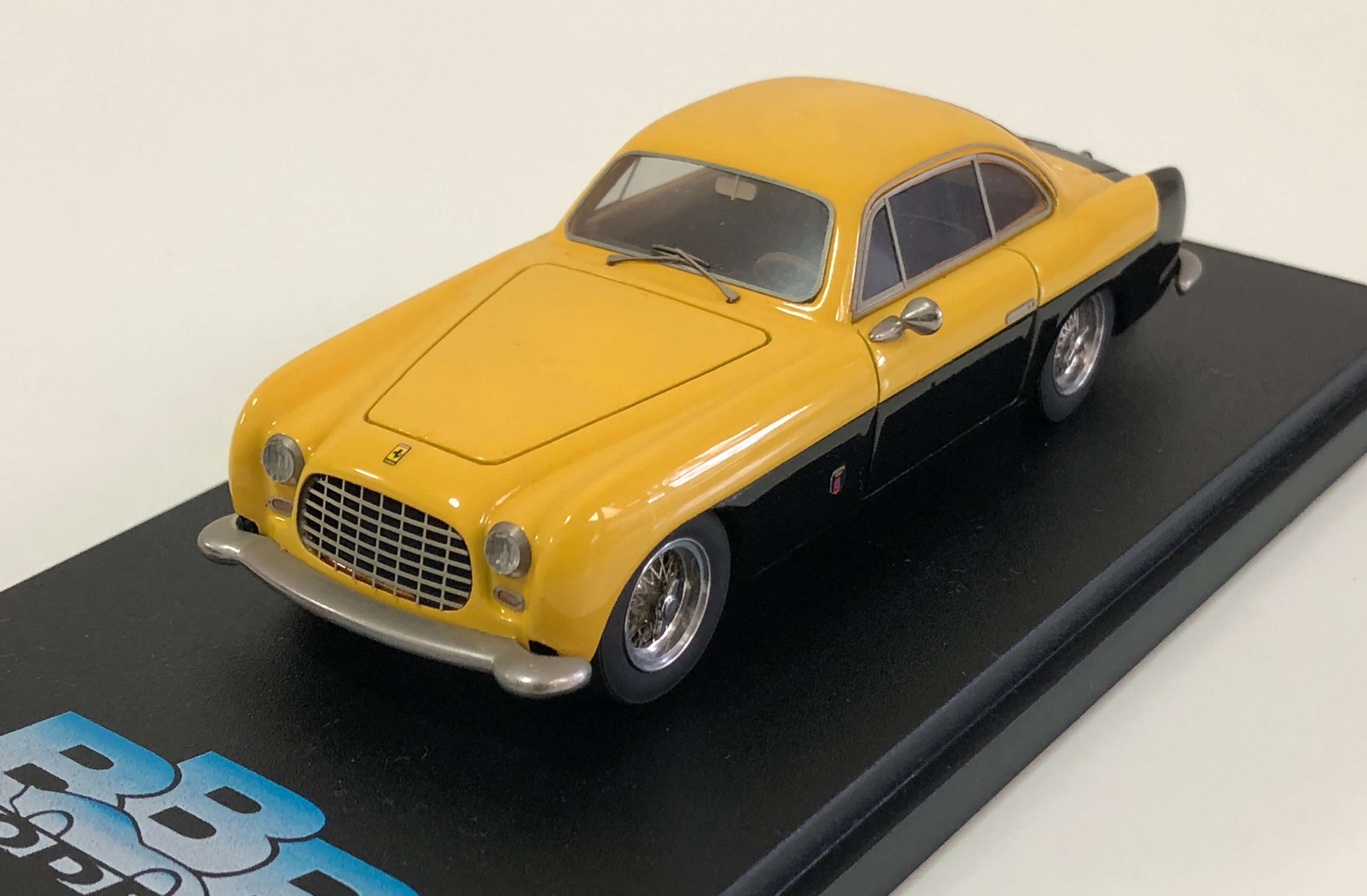 BBR: Ferrari 212 Inter Street (BBR85A)
OK, that's it for this update, so, what's on in October? Well, not a lot, just the regular 1st Friday, Sydney Toy and Hobby Fair on October 3 at the Epping Creative Centre, 26 Stanley Rod, Epping starting around 6:00pm. I hope to see you there. Until next month, happy collecting.
Road Cars
- 1952 Ferrari 212 Inter Street in yellow/black (BBR)
- 1972 Ferrari 365 GTB/4 in red (Matrix)
Australian Racing Series
- 1998 Commodore VS, C.Lowndes (15)ATCC winner (Biante)
- 1998 Commodore VS, M.Skaife (50) ATCC (Biante)
After Thoughts: "An Unrivalled Hat-trick."
For the record, the 1977 German GP was won by Niki Lauda in his Ferrari 312T2B. The 24-car field started the race under a dropped German national flag as the red/green lights had been damaged by a service vehicle; the confusion of the start resulted in an accident near the back of the grid between Alan Jones and Clay Regazzoni, putting both drivers out on the spot. In the confusion of that hectic start, another car joined the race at the rear of the field.
1977 saw the debut of Gunter Schmid's ATS team, using the year-old Penske PC4 chassis from the defunct Penske works team with power from the Ford Cosworth DFV V8. For much of the year the team had been a single-car effort with Jean-Pierre Jarier, but with the German GP coming up, Schmid decided to put a local driver in a second car for extra attention. German driver, Hans Heyer was one of the most versatile sports car and touring car drivers in the 1970s and 1980s, a gun for hire who never permanently aligned himself with one make. His DRM (German National Series) exploits in particular, had made him a household name in Germany. So, Heyer got the nod for his F1 debut despite being 34 years-old, and with only one single-seater start beforehand in F2 the previous year.
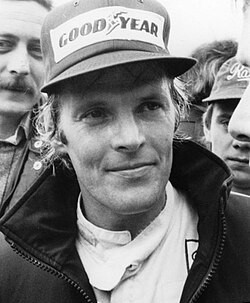 Hans Heyer, photo taken late 1970's
During qualifying for the race, Heyer recorded his best time all weekend, a 1 minute 57.58, but it was only the 27th quickest time, so he had failed to qualify for the 24-car grid. Patrick Nève (March-Ford), and Emilio de Villota (McLaren-Ford) set the 25th and 26th fastest times respectively, so Heyer was the third reserve driver, meaning he would get to race if three drivers failed to make the starting grid. However, Frank Williams chose not to prepare his driver, Nève for the race, and Emilio de Villota, who was the second reserve, had a last-minute engine failure before the race, so Heyer had effectively become the first reserve driver.
Even as first reserve, Heyer was still a long shot to start the race. Nevertheless, he climbed aboard his car as the race approached, perhaps hoping for a last-minute break. But as it turned out, he had a devilish plan up his sleeve. Perhaps egged on by his team and trusting in the goodwill of the local officials, Heyer took advantage of the confusion at the start. The lights failed, and the German flag had to be dropped to start the race. When Jones and Regazzoni collided at the first corner, Hans drove out of pit lane and joined the pack. The crowd, realising what was going on, went ballistic. Indeed, the crowd seemed to have more of a clue of what was happening than the stewards, who either failed to notice or ignored the illegal 25th car on the circuit. As it turned out, Hans retired after 9 laps with a gear linkage problem having set the 22nd fastest race lap, and it was only after he had pulled out that he was disqualified from the final results.
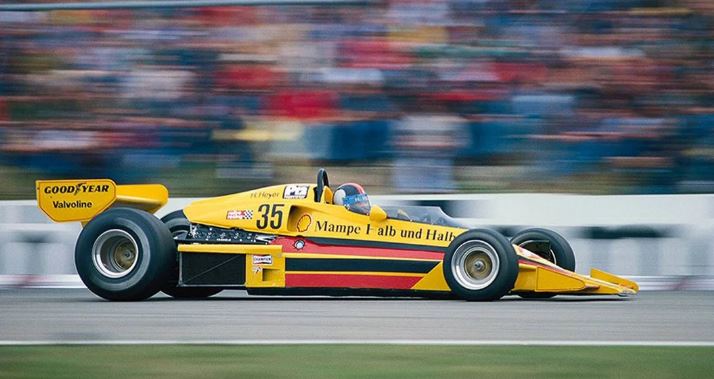 Hans Heyer's ATS Ford, 1977 German GP
When Hans Heyer started the race he became the only driver to be credited with a DNQ (did not qualify), DNF (did not finish), and DSQ (disqualified) in the same race! Heyer was immediately banned from competing in the next five F1 races which effectively became a lifetime ban because he had no intention to compete any further in F1. Hats off to him for pulling a stunt that no one would be able to get away with today.
New Additions: September 2025
Hello and welcome to another monthly update. Let me firstly thank all those who visited my garage at the recent CMC Shannons Sydney Classic on August 17. What a glorious weekend it was; an island of rare sunshine surrounded by torrential rain before and afterwards. I hope everyone enjoyed the day.
I did receive a package of models last month which contained mostly Maxichamps road cars; these cars, produced by Minichamps are very good value with good detail. I also found hidden away in storage and long forgotten, several Falcon XY GTHO Ph3 and Holden EH models from the Biante Reserve Collection which were released around 2010/11. These diecast models feature opening parts; bonnet, boot and doors which is a rarity these days in 1:43 so they are my featured models this month.
Released in 1963, the EH has was one of Australia’s most popular selling cars. With a new engine, clever styling changes, and competitively priced, the EH was the fastest selling car in Australia at the time. The new powerplant, dubbed the ’Red’ engine was more powerful and economical than the previous ‘Grey’ engine, it also required less maintenance. Catering to a wide audience, the EH was available in nine different models. The "Special" sedan and wagon models came equipped with stainless moulding strips all round, special badges and optional two-tone paint jobs.
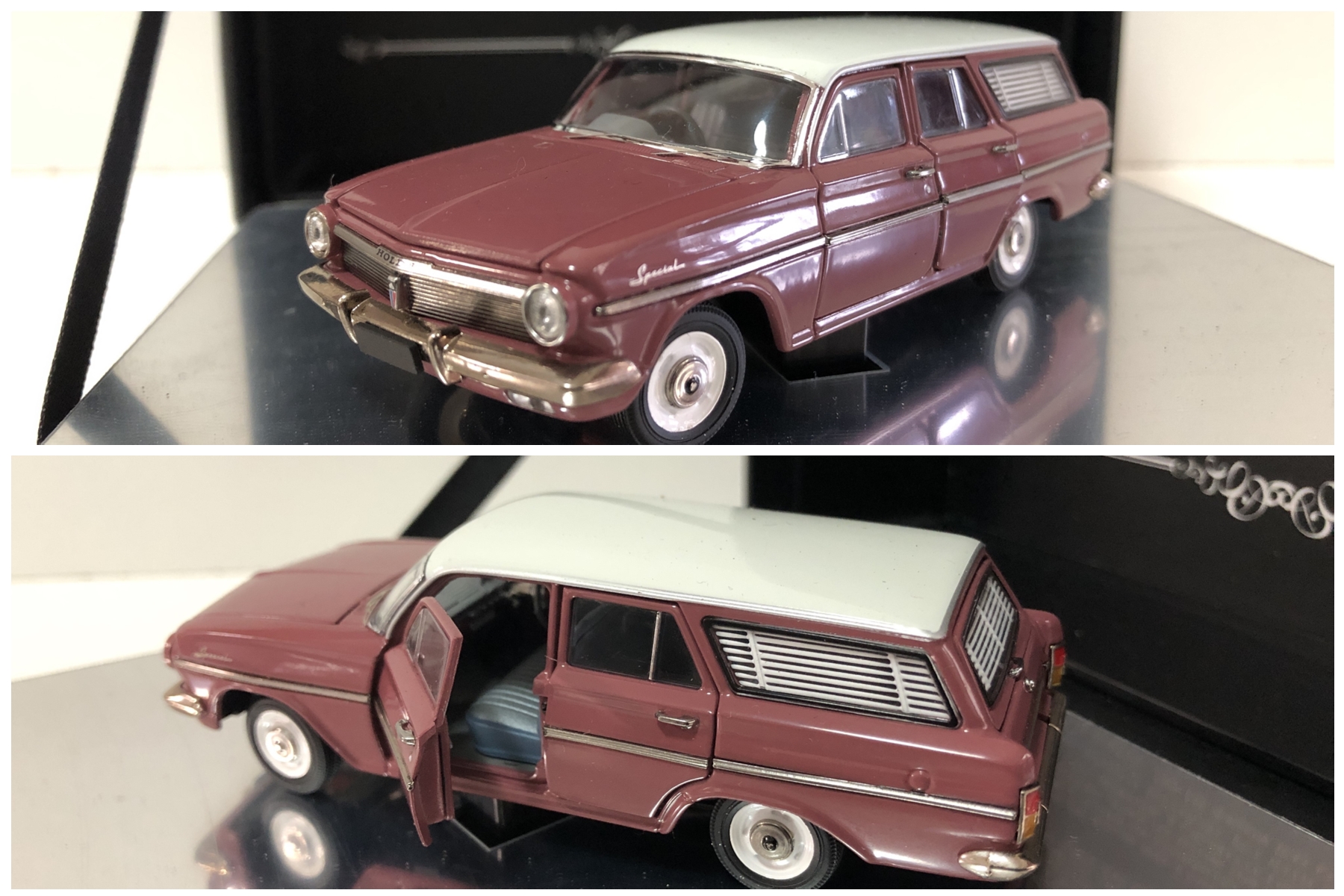 Biante: EH Holden (fowlers ivory/mauve)
The Ford Falcon XY GTHO Phase III was a limited-production Australian muscle car, built in 1971, that was designed to dominate racing and was known as the world's fastest four-door sedan at the time. Only 300 were produced from May 1971 to November 1971, featuring a 351 cubic-inch V8 engine, and it achieved significant motorsport success, including a 1-2-3 finish at the 1971 Bathurst 1000.
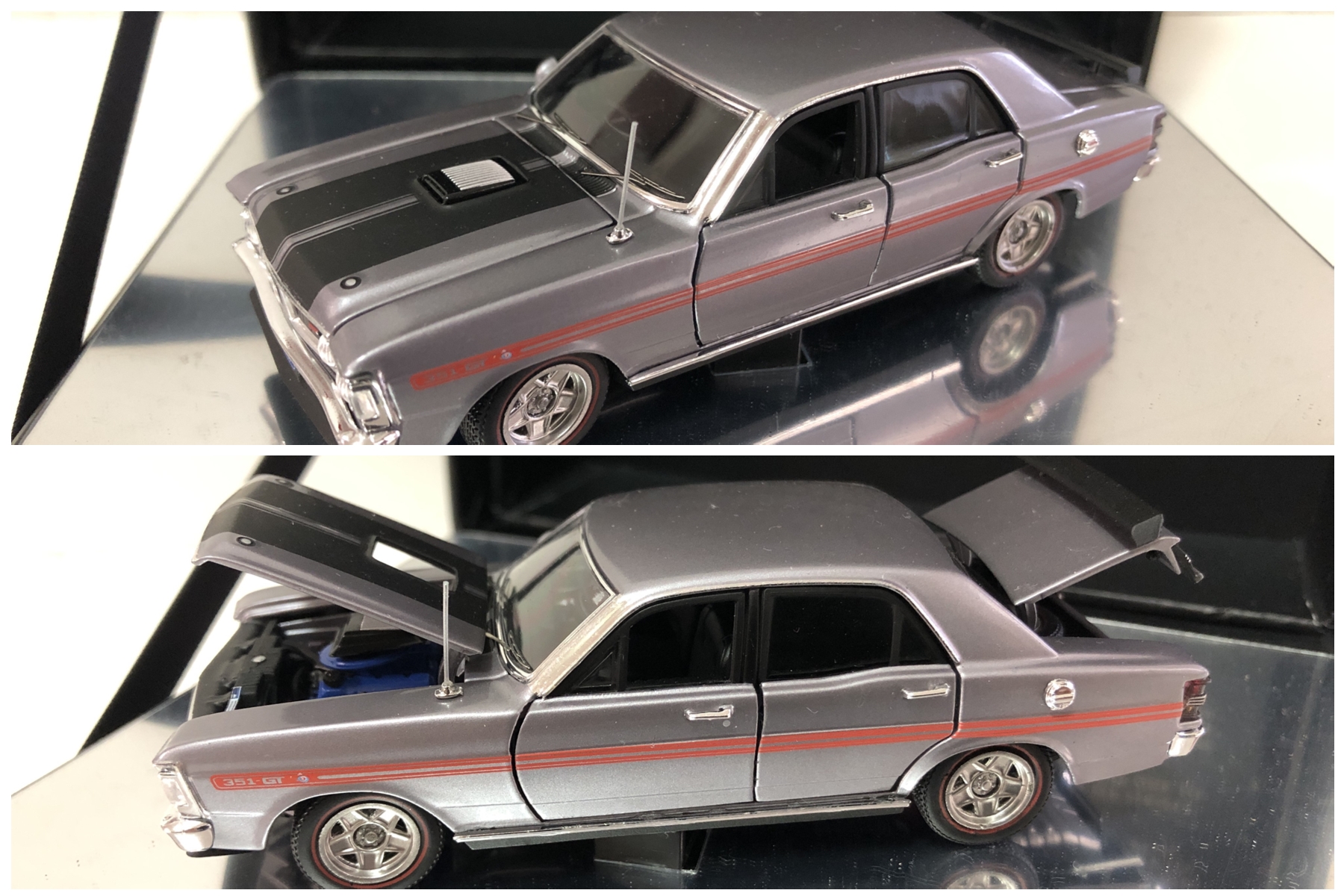 Biante: Falcon XY GTHO Ph3 (Frosted Pewter)
OK, that wraps up another monthly update, so where will I be in September? The regular monthly Sydney Toy and Hobby Fair is on September 5 at the Epping Creative Centre, 26 Stanley Road, Epping. Then on September 14, the annual All British Day will be held at the Hawkesbury Showgrounds, Clarendon. Finally, on the following weekend of September 20-21, I will be at the Hawkesbury Model and Hobby Show which is part of the Clarendon Classic Machinery Rally, again held at the Hawkesbury Showgrounds. I hope to see you at one of these events, if not all three! Until next month, happy collecting.
Road Cars
- 1968 Alfa Romeo GTA 1300 Junior in red (Maxichamps)
- 1972 Alfa Romeo 1600 Junior Z in red (Maxichamps)
- 1976 Alfa Romeo Alfetta GTV in white (Maxichamps)
- 1992 Alfa Romeo 155 in red (Maxichamps)
- 1972 BMW 520 in red (Maxichamps)
- 1972 Ford Gran Torino Sport in red (IXO)
- 1994 Ford Mustang Cabrio in red (Maxichamps)
- 1971 Falcon XY GTHO P3 in nugget gold (Reserve Collection) (Biante)
- 1971 Falcon XY GTHO P3 in frosted pewter (Reserve Collection) (Biante)
- 1972 Falcon XY GTHO P3 in jewel green (Reserve Collection) (Biante)
- 1981 Ford Escort in light gray (Maxichamps)
- 1963 Holden EH Special Sedan in fowlers ivory/red (Reserve Collection) (Biante)
- 1963 Holden EH Special Sedan in warrigal black (Reserve Collection) (Biante)
- 1963 Holden EH Special Wagon fowlers ivory/mauve (Reserve Collection) (Biante)
- 2017 Commodore VFII SSV Redline Ute in heron white (Biante)
- 1990 Honda Civic in black (Maxichamps)
- 1955 Mercedes Benz 190 SL (W121) in silver (Maxichamps)
- 1968 Mercedes 200/8 Series 1 in light gray (Maxichamps)
- 1970 Mercedes 280 SE 3.5 (W111) in metallic light blue (Maxichamps)
- 1984 Mercedes 190E 2.3-16 (W201) in black (Maxichamps)
- 2008 Mercedes SL-Class (R230) in metallic red (Maxichamps)
- 1989 Porsche 944 S2 in white (Maxichamps)
- 1990 Porsche 911 (964) Turbo in white (Maxichamps)
- 1972 VW T2 Bus in green/white (Maxichamps)
- 1973 VW Beetle 1303 S in yellow/black (Minichamps)
- 1974 VW Beetle 1303 in black (Maxichamps)
Australian Racing Series
- 2012 Ford Falcon FG, Moffat/Davison (17) Bathurst retro "Tru-Blu" livery (ApexReplicas)
- 2013 Ford Falcon FG, Mostert/Wood (17) Bathurst retro "GreensTuf" (ApexReplicas)
- 1982 Commodore VH, P.Brock/L.Perkins (05) "Marlboro" Bathurst winner (ACE)
Le Mans
- 1970 Porsche 917K, Herrmann/Attwood (23) LM winner (IXO)
- 1971 Porsche 917K, Marko/Van Lennep (22) Le Mans winner (IXO)
Helmets
- 1961 S.Moss - Rob Walker Racing Helmet 1:5 (Spark Editions)
- 2009 V.Rossi (46) MotoGP Champion 1:5 (Spark Editions)
After Thoughts: "The Great Designers - Owen Maddock."
Owen Richard Maddock was a British engineer whose innovative designs transformed Formula 1. Trained as an engineer, he joined the newly founded Cooper Car Company in 1948. As chief designer at Cooper between 1950 and 1963, Maddock permanently reshaped single-seater racing. His cars—compact, clever, and often unorthodox—ushered in the rear-engine revolution that forever changed the face of Formula One.
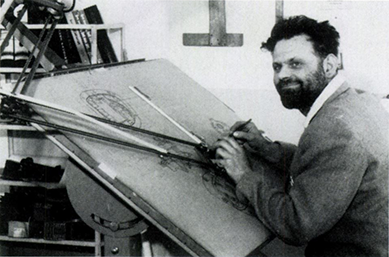 Owen Maddock (photo: Doug Nye)
Hired initially by Cooper as a fitter, van driver, and storekeeper, Maddock’s sharp eye for engineering soon caught the attention of Charles Cooper. His skills as a draughtsman elevated him quickly through the ranks, and within a short time he was installed as Cooper’s chief designer.
Ironically, Owen Maddock's first Formula One design wasn't actually produced for the Cooper Car Company. In early 1953 industrialist, Tony Vandervell approached the Coopers to obtain their assistance in building a chassis for his forthcoming racing engine. The resulting Vanwall Special was built at the Cooper factory and was designed from the ground up by Maddock. A further four chassis were constructed to Maddock's design the following year, in Vandervell's own Vanwall racing team's premises in London.
Maddock’s first major breakthrough came in 1954, when he questioned the prevailing orthodoxy of chassis construction. Instead of the traditional straight tubes, he introduced curved chassis tubing to better fit the contours of the car. This eliminated unnecessary supports, lightened the structure, and allowed more compact, efficient designs.
His biggest breakthrough came with the adoption of rear-mounted engines. The idea of placing the engine behind the driver was not entirely new, but Maddock was the first to fully unlock its potential. Rear-engined Coopers benefited from superior weight distribution, reduced overall mass, and improved aerodynamics. The vindicating moment arrived in 1958 when Stirling Moss drove the Cooper T43 to victory in Argentina, the first Formula One win for a mid-engined car. Maddock’s design had changed history.
The following year, the Cooper T51, again designed by Maddock, carried Jack Brabham to the Drivers’ Championship and secured the Constructors’ title for Cooper. In an instant, decades of front-engine doctrine were relegated to history. Success continued with Brabham clinching another title in 1960 with the T53. In addition to his Formula One work, Maddock also produced race-winning Formula Two, Formula Three and sportscar designs.
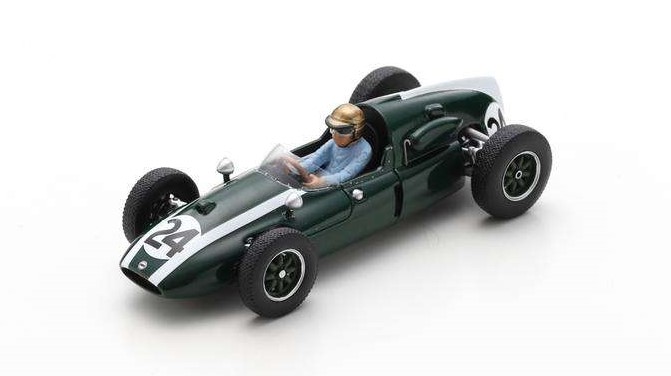 Spark: Cooper T51 Brabham Monaco GP 1959
Despite the successes, Cooper’s fortunes declined after 1961, as changing engine regulations and Brabham’s departure undermined their competitiveness. Lotus and Colin Chapman surged ahead. Feeling trapped within the confines of the drawing office, and excited by the development of hovercraft technology, Maddock left Cooper and motorsport in 1963, although he continued to freelance for Bruce McLaren’s fledgling new team in the 60s. His visionary days were far from over. He was to pioneer the use of aeronautical honeycomb in chassis design long before it became an F1 standard.
Beyond engineering, Maddock was a talented jazz musician, playing saxophone, bass clarinet and piano. Brilliant, unconventional, and far-sighted, Owen Maddock remains one of the key figures who shaped modern Formula 1. Owen Maddock passed away in July 2000.
New Additions: August 2025
Hello and welcome to the August update. I've restocked on a number of IXO Le Mans winners this month, always a popular collecting theme and also some classic Ferrari sport cars that raced in the 1950's to the 1970's. A handful of road cars also made it into the inventory, but one model in particular captured my attention.
At the 2023 24 Hours of Le Mans one bright green car stood out and became an instant fan favorite. This car, a Porsche 911 RSR entered by Project 1-AO Racing, featured a green Tyrannosaurus Rex design, complete with a toothy grin, little arms, and big feet. The livery was inspired by the children of AO Racing team co-founder and driver PJ Hyett, and the car quickly gained the nickname "Rexy". The livery made its first appearance at the 12 Hours of Sebring, the second round of the 2023 IMSA SportsCar Championship season and "Rexy" was so warmly received in the North American endurance championship that the team knew it was only fitting to bring it to Le Mans. The #56 Porsche was entered under the Project 1-AO banner, competing in the LMGTE Am class where it led for nearly half the race. After 23 hours of flawless driving, disaster struck. With the finish line in sight, Rexy suffered a suspension issue, forcing an unscheduled pit stop. The team lost three laps in repairs—enough to dash any hopes of a podium. When the checkered flag fell, the #56 Porsche was classified 7th in class. Despite the unlucky ending, Rexy emerged as one of the true stars of Le Mans 2023. This dinosaur-themed Porsche proved that racing can still be fun in an era of sleek corporate branding and sponsorship. Rexy proved to be a hit not only with the racing fans but with model car collectors as well. This model is from IXO.
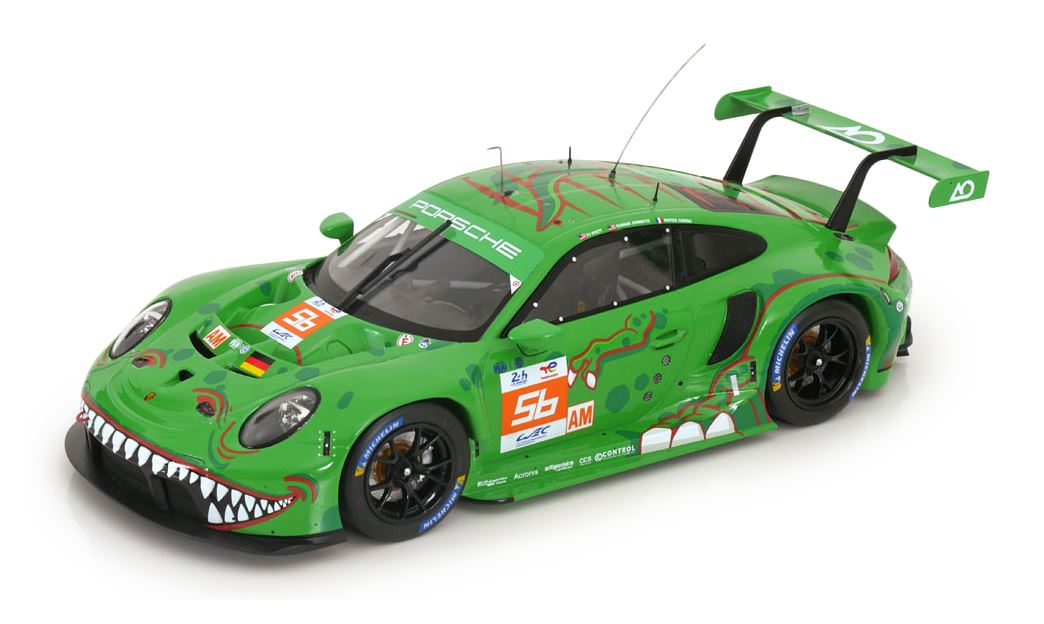 IXO: 2023 Porsche 911 RSR Le Mans "Rexy"
Well, that's it for another month. So, what's happening in August? There's the regular Sydney Toy and Hobby Fair on the 1st of August at the Epping Creative Centre, 26 Stanley Road, Epping. Then on the 17th of August, I will be attending the annual Shannons Sydney Classic at the Sydney Motorsport Park, Eastern Creek. I will be in garage 19 again so come and say hi. Until next month, happy collecting.
Le Mans / Sports Cars
- 2008 Audi R10 TDI, Capello/Kristensen/McNish (2) LM Winner (IXO)
- 1930 Bentley Speed Six, Barnato/Kidston (4) Le Mans winner (IXO)
- 1949 Ferrari 166M, L.Chinetti/P.Mitchell-Thomson(22) LM winner (IXO)
- 1954 Ferrari 375 Plus, Gonzalez/Trintignant (4) winner Le Mans (IXO)
- 1958 Ferrari 250 TR, O.Gendebien/P.Hill (14) 1st Le Mans (Altaya)
- 1960 Ferrari 250 California, Sturgis/Schlesser (20) Le Mans (Altaya)
- 1960 Ferrari TR60, Gendebien/Frere (11) Le Mans winner (IXO)
- 1961 Ferrari 250 TR61, Gendebien/P.Hill (10) Le Mans winner (IXO)
- 1961 Ferrari 250 TRI, Bandini/Scarletti (4) Pescara 4Hr (Altaya)
- 1962 Ferrari 330 TRI, Gendebien/Hill (6) 1st Le Mans (IXO)
- 1963 Ferrari 250 P, Surtees/Mairesse (110) 1st Nurburgring 1000Km (Altaya)
- 1964 Ferrari 250 GTO, Vaccarella/Rodriguez (26) Reims 12Hr (Altaya)
- 1964 Ferrari 250 GT Lusso, Taormina/Tacci (120) Targa Florio (Altaya)
- 1965 Ferrari 250LM, J.Rindt/M.Gregory (21) Le Mans winner (IXO)
- 1967 Ferrari 330 P4, Bandini/Amon (23) 1st Daytona 24hr (Altaya)
- 1971 Ferrari 512 M, Merzario (22) 1st Imola 300km (Altaya)
- 1978 Ferrari 365 GT4 BB, Migault/Guitteny/Young (5) Daytona 24Hr (Altaya)
- 2019 Ford GT, Briscoe/Dixon/Westbrook (69) Le Mans (IXO)
- 1972 Matra Simca 670, G.Hill/Pescarolo (15) Le Mans winner (IXO)
- 1991 Mazda 787B, Weidler/Herbert/Gachot (55) Le Mans Winner (Edicola/Spark)
- 2009 Peugeot 908 HDI FAP, Brabham/Gene/Wurz (9) winner Le Mans (IXO)
- 1984 Porsche 956L, Pescarolo/Ludwig/Johansson 1st LM (7) Newman (Edicola/Spark)
- 2022 Porsche 911 RSR-19, Fassbender/Campbell/Robichon (93) Le Mans (IXO)
- 2023 Porsche 911 RSR, Hyett/Jeannette/Cairoli (56) LM "Rexy" (IXO)
Road Cars
- 2019 Mercedes CLA Coupe (C118) in jupiter red (Spark for Mercedes)
- 2019 Mercedes CLA Shooting Brake in denim blue (Spark for Mercedes)
- 2021 Mercedes EQB in digital white (Herpa for Mercedes)
- 2021 Mercedes C Class (W206) in opalite white (Herpa for Mercedes)
- 1977 Peugeot 504 Cabrio in white (Maxichamps)
- 1972 VW-Porsche 914/4 in green (Maxichamps)
After Thoughts: "A Life in Motion and Colour."
For over six decades, Michael Turner has brought the speed, and spirit of both the sky and the track to life with brush and canvas. A repected figure in both the aviation and motor sport art worlds, Turner's work is instantly recognisable—technically accuracy, full of dynamic energy, with a deep respect for the machines and people behind them. Born in 1934 in Harrow, Middlesex, Michael grew up amid the turmoil of the Second World War. Like many children of the time, he was inspired by the exploits of the Royal Air Force but what set him apart was a talent for aircraft recognition—and an early aptitude for drawing. Even during school lessons, his exercise books became impromptu sketchpads filled with detailed illustrations of aeroplanes, much to the frustration of his teachers.
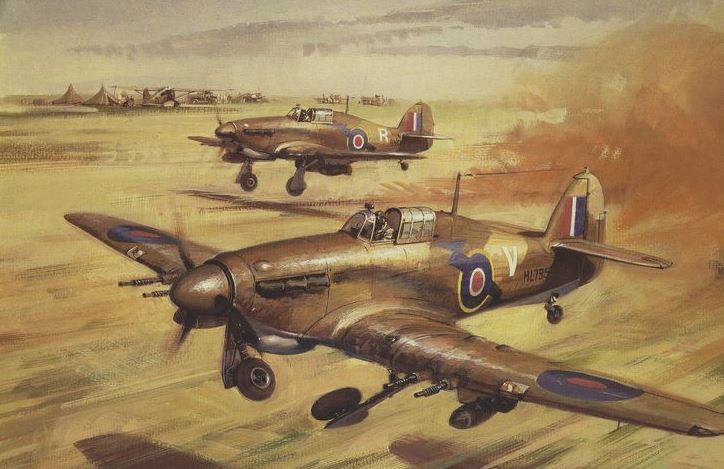 Hawker Hurricanes by Michael Turner
His love of aviation was soon joined by another high-octane passion: motor racing. In 1947, a family holiday to the Isle of Man coincided with the first post-war revival of the British Empire Trophy Race. From that moment, 13-year-old Michael was devoted to the speed and spectacle of motor sport and to spending a lifetime successfully recreating and recording his visual impressions of the sights and sounds of motor racing on paper and canvas.
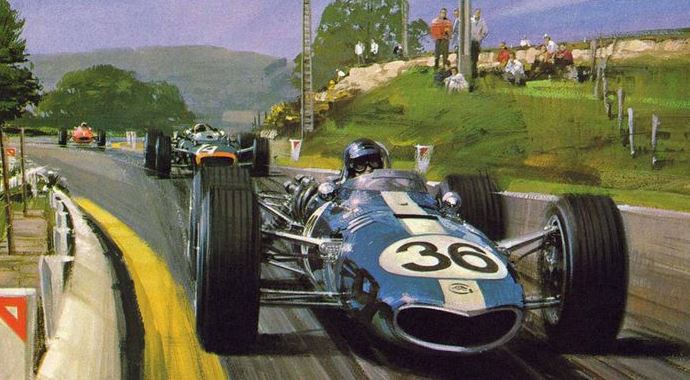 Dan Gurney's Eagle at Spa 1967 by Michael Turner
After completing his formal education and art college training, Michael served two years of National Service before joining London’s bustling advertising industry, finally taking the leap into freelance work in 1957. Michael's artistic philosophy was authenticity and realism. For him, capturing speed and flight means understanding them from the inside out. That drive for realism took him around the globe, from the world’s greatest racetracks to the cockpits of legendary aircraft. This passion and pursuit of firsthand experience has earned Michael a reputation unmatched in his field. He is a founding member and current President of The Guild of Aviation Artists, and an Honorary Fellow of the Guild of Motoring Artists. His paintings have been commissioned by racing legends, Formula One teams, air forces, and collectors worldwide. His work has graced exhibitions across London, New York, Australia, and Europe, and has been published in six books celebrating both aviation and motorsport.
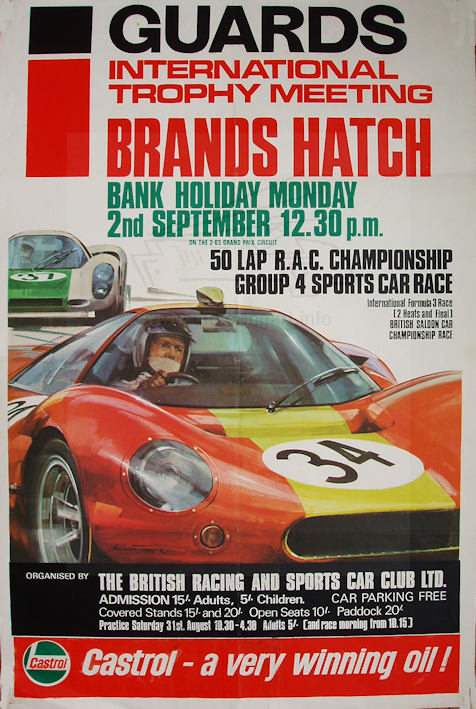 Michael Turner's artwork on 1968 Brands Hatch Poster
Despite all these achievements, Michael’s greatest legacy may well be the artistic passion he passed on to his son, Graham. Born in 1964, Graham Turner grew up surrounded by roaring engines, oil paint, and drafting tables. It’s no surprise that by age 16, he felt the same irresistible pull that had shaped his father’s life. Graham pursued his creative calling, studying Art & Design before spending two years with a London design studio.
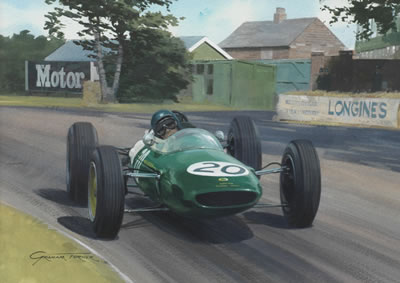 Clark's Lotus 25, 1962 British GP by Graham Turner
At just 20 years old, Graham went freelance—and never looked back. Like his father, Graham found inspiration in motor racing. For the first decade of his career, he focused almost exclusively on capturing iconic racing moments from all eras of the sport. Over the last 40 years, Graham has carved out his own place in the world of motorsport and historical art. Though shaped by Michael’s influence, his style is distinctly his own.
From sketching Spitfires in the margins of schoolbooks to capturing the drama of a Grand Prix at full throttle, Michael Turner’s story is one of passion and dedication — a legacy now carried forward by a new generation.
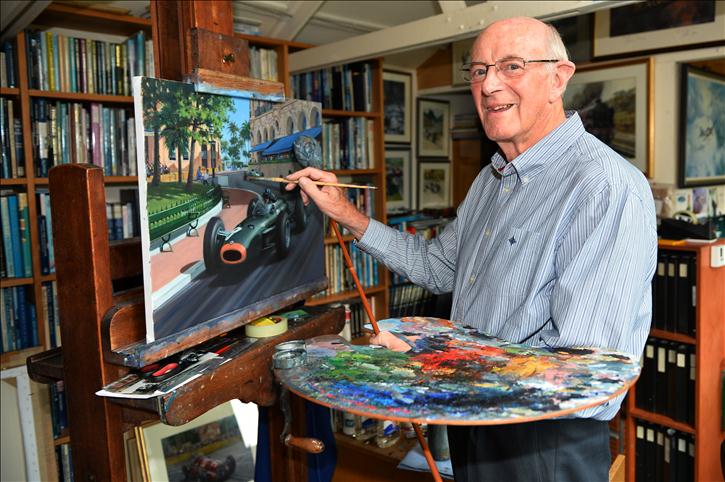 Michael Turner at work in 2013
New Additions: July 2025
Hello and welcome to another monthly update. It's hard to believe that we are now mid-way through the year and we'll soon be seeing Christmas trees and decorations being sold in the shops again. On the model scene, I received a small parcel, containing mainly Ferrari road cars by budget manufacturer, Altaya. These are from a Ferrari "partworks" series released in Europe where it seems retailing model cars via a magazine subscription is very popular. I chose one Ferrari at random to highlight this month and it turned out to be a good choice.
The Ferrari Superamerica combines stunning Ferrari V12 berlinetta performance with a highly original convertible. Its engine displaces 5748 cc to give it a top speed of 320 km/h and Ferrari marketed it as the world's fastest convertible car. The Superamerica was also the first production car to adopt an innovative 180° rotating roof incorporating electrochromic technology developed exclusively for large glass surfaces, which transforms it from a coupé to a convertible in just a few seconds.The result is a car that combines all of the prestige and allure of a drop-top with the functional advantages of a coupé. Its rotating roof has been dubbed Revocromico to highlight the combination of its rearward rotation movement and electrochromatic technology. Boasting a simple yet highly innovative single fulcrum rotational mechanism which opens and closes it very smoothly . Released in 2005, the total production of the Superamerica amounted to 559 units; this number followed Enzo Ferrari's philosophy that there should always be one fewer car available than what the market demanded. Although this 1:43 Altaya model is a low-budget model it still incorporates a functional rotating roof to mimic the real car - amazing.
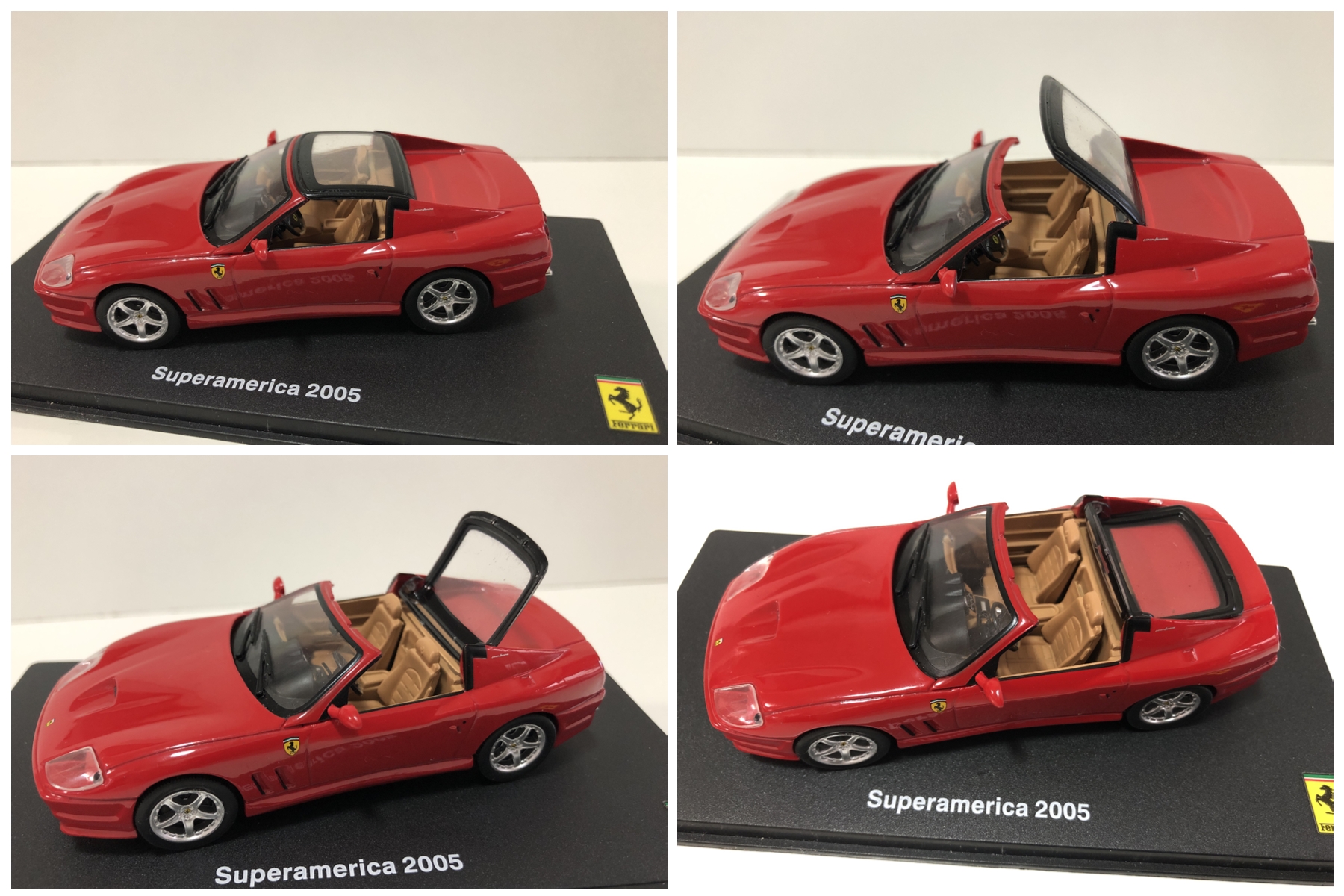 Altaya Ferrari Superamerica 2005
Ok, that's it for yet another month. So, what's on in July? It's going to be a relatively quiet month again with just the regular Sydney Toy and Hobby Fair on 4th July at the Epping Creative Centre, 26 Stanley Road, Epping. Things will begin to get busy from August onwards, right up to Christmas. Until next month, happy collecting.
Australian Racing Series
- 2015 Commodore VF, Lowndes/Richards (888) 1st Bathurst 1000 (Biante)
- 2018 Commodore ZB, C.Lowndes (888) Newcastle 500 Last Full Time drive (Biante)
- 2020 Commodore ZB, Van Gisbergen/Tander (97) 1st Bathurst 1000 (1:64 Biante)
- 2021 Commodore ZB, J.Whincup (88) Sydney Supernight Last Full Time drive (Biante)
- 2022 Commodore ZB, Lowndes/Fraser (888) Bathurst 1000 wildcard (Biante)
Road Cars
- 1940 Ferrari Auto Avio Costruzioni 815 in red (Altaya)
- 1957 Ferrari 250 GT Berlinetta in red (Altaya)
- 1996 Ferrari 550 Maranello in red (Altaya)
- 2004 Ferrari F430 in red (Altaya)
- 2005 Ferrari SuperAmerica in red (Altaya)
- 2009 Ferrari 458 Italia in red (Altaya)
- 2011 Ferrari 458 Spider in red (Altaya)
- 2014 Ferrari California T in metallic blue (Altaya)
- 2015 Ferrari 488 GTB in red (Altaya)
- 1962 Ford Cortina Mk I in grey (Maxichamps)
- 1974 Lancia Stratos in red (Maxichamps)
- 1984 Maserati Biturbo Spyder in silver (Maxichamps)
- 2011 McLaren 12C in yellow (Maxichamps)
1:18 Models
- 1997 Commodore VS, P.Brock (05) Winner Round 8 (Last ATCC win) (Biante)
- 2005 Elfin Streamliner MS8, P.Brock Classic Adelaide Rally (Classic Carlectables)
After Thoughts: "The Race Nobody Wanted To Win."
The Monaco Grand Prix has a deserved reputation as being processional and dull, where qualifying well is the key to success in the race. The narrow, unforgiving streets and the tight layout makes overtaking extremely difficult. However, when fans talk about the greatest Formula One races of all time, the 1982 Monaco Grand Prix is always mentioned — not because of wheel-to-wheel duels or high-speed battles, but for its utterly chaotic and unpredictable ending.
Held on 23 May 1982, the race was the sixth round of a tragic season, marked by the death of Ferrari driver Gilles Villeneuve just two weeks prior. The sombre mood lingered over the paddock, but Monaco delivered a race that no one could have possibly foreseen. As always in Monaco, qualifying was critical. René Arnoux took pole position in his powerful Renault RE30B, followed by Riccardo Patrese in the Brabham-Ford and Didier Pironi in the sole Ferrari.
Arnoux led early on and quickly forged a decent buffer to the pack but spun out on lap 15 at the Swimming Pool, stalling his engine. A number of other drivers were getting caught up in incidents further back on the narrow, unforgiving streets, including Pironi, who was now driving without his nose cone but still able to continue. Alain Prost took over the lead from Arnoux and held it until the closing stages of the 76-lap race, managing to extend his lead over Patrese in second place. With just a handful of laps remaining, it started to rain. But Prost kept the hammer down, maintaining his advantage over Patrese's Brabham despite the Brabham handling better in the damp conditions.
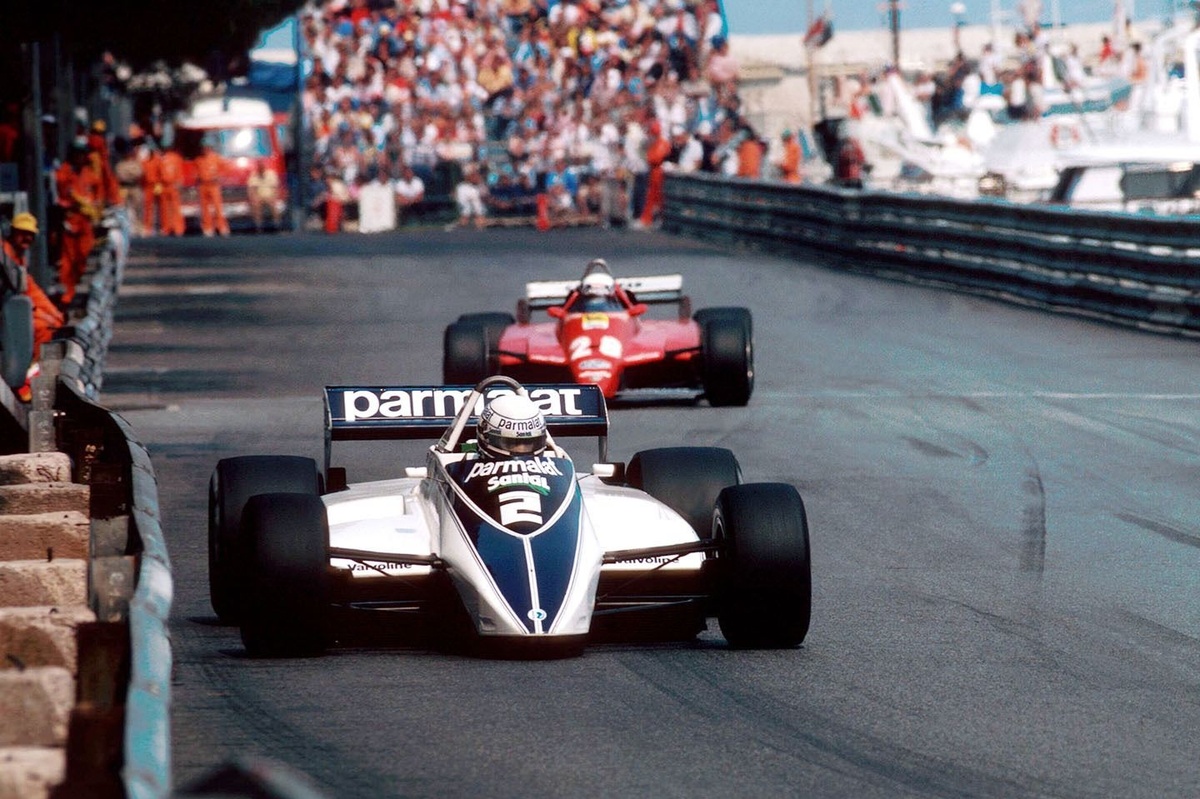 Patrese leading Pironi (Ferrari) 1982 Monaco GP
Then the rain started to grow heavier with 15 laps to go. None of the drivers wanted to pit for a change of tyres so close to home, but they faced trouble keeping out of the wall. Keke Rosberg hit the wall 11 laps from the finish while chasing Andrea de Cesaris (Alfa) for fourth. Michele Alboreto took up the challenge to pass the Alfa Romeo ahead, only to also retire when his rear suspension failed in the final seven laps. Derek Daly was driving without a rear wing on his Williams after clouting a barrier. His damaged gearbox was leaking oil on the track, leaving the circuit like an ice rink for the other eight cars still running in the race.
Prost looked bound for victory entering the final three laps, but as the Renault came through the chicane exiting the tunnel, the rear-end flung around and speared into the barrier on the right-hand side of the track. His car bounced back into the barrier on the opposite side, shedding the wings at each end and one of its wheels. Prost was left to hop out of his car, knowing a maiden Monaco win had just been thrown away.
Patrese had been able to pass the crash site safely, moving into the lead for Brabham. On the penultimate lap, Patrese's car snapped sideways on the slight kink towards the Loews hairpin after hitting the oil from Daly's car, leaving his car facing back uphill. The crowd gasped—his race was over… or so it seemed. Patrese allowed his car to roll backwards before being given some help by the marshals, who adjudged the car was in a dangerous place. "There were discussions about being disqualified, but the marshals had pushed me because I was blocking the road," Patrese said. "After that, they left me but fortunately the nose was pointing downhill and started to roll, so I could restart the engine."
While Patrese was able to get his car back running, he failed to do so before both Pironi and de Cesaris were able to file past at the hairpin, demoting the Brabham to third place. Pironi was running cautiously given the loss of downforce from his missing front wing and the tricky track conditions, but he was almost at a crawl as cars around him passed to un-lap themselves. As Pironi began his final lap, the tank in his car ran dry as he ground to a halt in the tunnel. That should have handed the lead to de Cesaris, but he too had run out of fuel just a few hundred metres earlier at Casino Square. Less than one lap from home, de Cesaris had missed out on a maiden victory, he would bow out of F1 some 12 years later with the unwanted record of the most races started without a win (now surpassed by Nico Hulkenberg).
BBC commentator and 1976 world champion James Hunt commented, "Well, we've got this ridiculous situation where we're all sitting by the start-finish line waiting for a winner to come past, and we don't seem to be getting one!" Derek Daly was the next leader but the damaged gearbox in his Williams seized up before he could start the final lap. But, through the chaos, Patrese was able to round the final few corners and cross the line to score his first grand prix victory - unaware at first that he had actually won. "When I crossed the line, I had no idea I won because we didn't have radios in those days," said Patrese, post-race. The last lap of the 1982 Monaco Grand Prix has been called “the most confusing in F1 history.” Even the television commentators and timing officials had no idea who was leading or had won until the cars came to a stop.
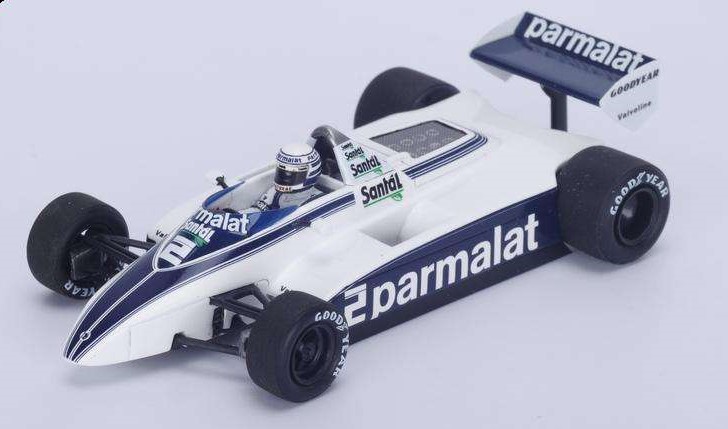 Spark (S4789): Patrese's 1982 Brabham BT49D
Joining Patrese on the podium were Pironi and de Cesaris, neither of whom had actually taken the chequered flag. As both had already lapped the rest of the field, it meant they finished ahead of fourth-placed Nigel Mansell. De Angelis took fifth for Lotus, while the stricken Daly rounded out the points in sixth for Williams. It was Patrese’s first-ever Formula One victory, and Brabham’s first win in nearly five years.
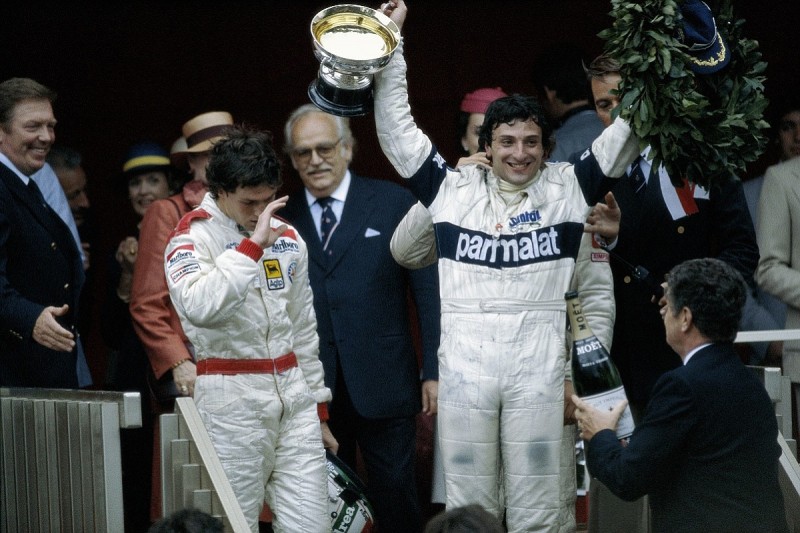 Riccardo Patrese celebrating his maiden win
The 1982 Monaco GP wasn't won by raw speed or dominant performance—it was a victory defined by attrition, misfortune, and good luck in equal measure. In just a few laps, five different drivers had a shot at glory, only to be undone by Monaco's tight confines, mechanical gremlins, or simple misjudgment in the wet conditions. At the end, just 10 drivers were classified as finishing the race, but only 5 were still under their own power, truly a race that nobody wanted to win.
New Additions: June 2025
Welcome to the June update and the start of winter. As the days get colder and shorter, it's a great time to focus on your indoor hobbies, like your prized collection of model cars. Perhaps it's time to rearrange the display cabinet(s) and to assess what's missing from your collection. Maybe I can help with the last part! But before I continue, I'd like to thank all those who dropped by my stall at last weekend's Collector Con at Penrith. The Collector Con certainly draws in a big crowd, unfortunately most are not model car collectors; they are there mostly for the action figures, trading cards and other toys. I will be attending one more Collector Con in November and I will then decide if it's worth attending next year. OK, back to the models. I did receive some models and there's one that is really interesting.
The Mercedes-Benz C111 was a series of experimental automobiles produced in the 1960s and 1970s. Mercedes was experimenting with new engine technologies, including Wankel engines, diesel engines, and turbochargers, and used the basic C111 platform as a testbed. Other experimental features included multi-link rear suspension, gull-wing doors and a luxurious interior with leather trim and air conditioning. The first version of the C111 was completed in 1969. The car used a fiberglass body shell and with a mid-mounted three-rotor direct fuel injected Wankel engine. However, Mercedes decided not to adopt the Wankel engine and turned to diesel experiments for the second and third C111s. The C111-IID's engine was a Mercedes-Benz OM 617, and produced 140 kW (188 hp). Neo's 1:43 scale C111-IID would be a welcome addition to any Mercedes collection.
 Mercedes-Benz C111-IID in the Mercedes Museum.
OK, that's it for another month, so what's on in June? It's going to be a relatively quiet month with just the regular Sydney Toy and Hobby Fair on 6th June at the Epping Creative Centre, 26 Stanley Road, Epping. Until next month, happy collecting.
American Racing Series
- 1986 March 83G Porsche, Adams/Hotchkis (00) Riverside 6 Hour 6th (Spark)
- 1973 Porsche 917/30 Turbo Spyder, M.Donohue (6) Can-Am Mosport 7th (Spark)
- 1982 Porsche 935 JLP-3, John Paul/John Paul Jr.(46) Road Atlanta 500K 1st (Spark)
- 1984 Porsche 962, Holbert/Bell/Adams (14) Watkins Glen 3Hr IMSA 1st (Spark)
- 1988 Porsche 962C, Wollek/Baldi/Redman (67) Daytona 24 Hrs 2nd (Spark)
- 1989 Porsche 962C, Herzog/Hytten (2) IMSA Sears Point (Spark)
Road Cars
- 1966 Chevrolet Nova SS Hardto in metallic dark green (Neo)
- 1952 Cunningham C3 Continental Coupe by Vignale in silver/metallic grey (Neo)
- 1976 Mercedes-Benz C111-IID in metallic orange (Neo)
After Thoughts: "Tarf Bisiluro: Piero Taruffi’s Twin-Torpedo Record Breaker."
In the world of record-breaking race cars, few have ever matched the futuristic design of the Italcorsa Tarf, also known as the Bisiluro, meaning “Twin Torpedo” in Italian. Designed and driven by Piero Taruffi, an Italian racing driver and engineer, the Tarf was not only revolutionary in appearance but in performance, setting an astounding 22 international speed records between 1948 and 1957. Piero Taruffi was a competent race driver who competed in Formula One from 1950 until 1956. During his F1 career he drove for some big teams, like Mercedes-Benz, Ferrari, Maserati and Alfa Romeo. During his career he won a couple big events, the 1952 Swiss Grand Prix and the last-ever Mille Miglia in 1957.
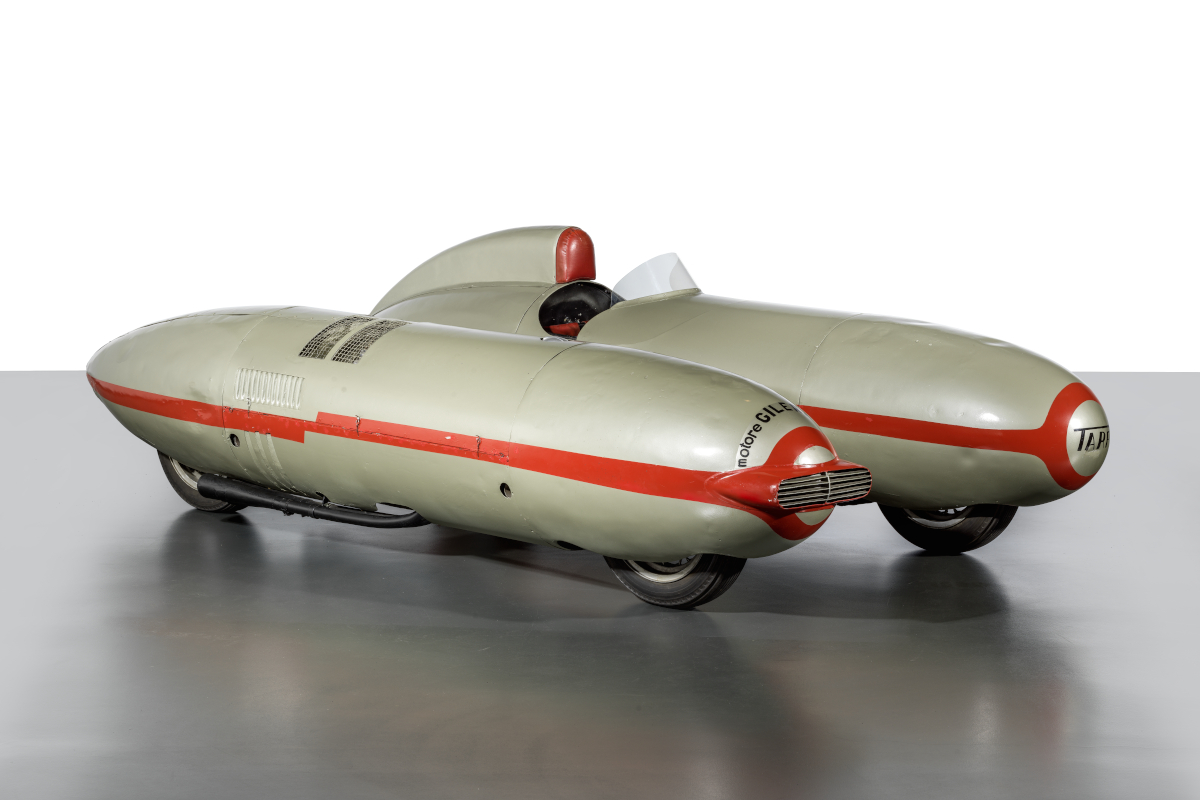 Tarf I displayed at the Turin National Automobile Museum
A mechanical engineer by training, Taruffi authored several books on racing technique and automotive engineering but his biggest dream was to completely redesign the race car. So in 1948 he came up with the Italcorsa/Tarf I. The Tarf wasn’t just ahead of its time—it looked like it came from another planet. Built on two separate steel tube chassis wrapped in aerodynamic "teardrop" cladding, the car was split into two distinct fuselages: the left pod housed the driver, while the right pod contained the engine, transmission, and fuel tank. Each component was optimized for speed and aerodynamics, with all-independent suspension and chain-driven rear wheels.
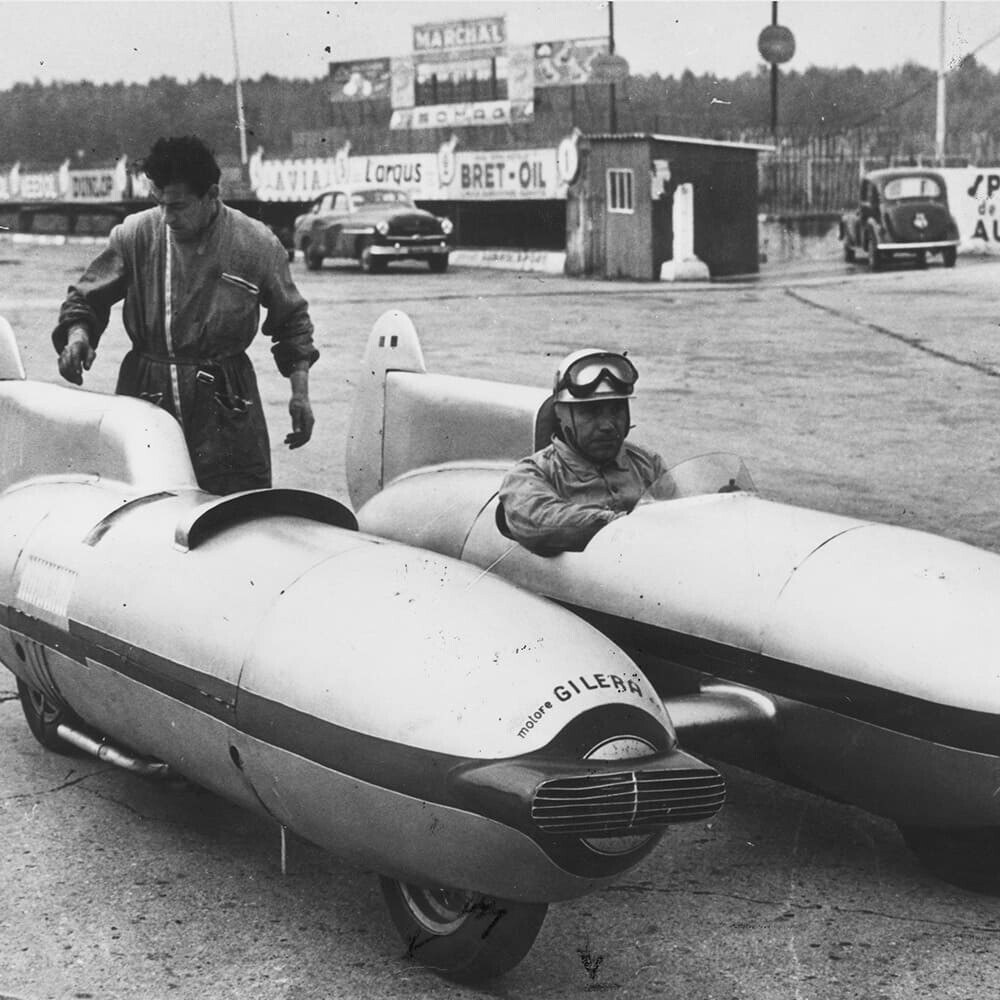 Tarf I with Taruffi preparing for a run
The first version of the car, the Tarf I, debuted in 1948 and was powered by a modest 500cc Moto Guzzi V-Twin, producing around 50 horsepower. Weighing just 300 kg, this minimalist missile was able to reach speeds up to 208 km/h (130 mph)—an astonishing feat for such a small-displacement engine. With it, Taruffi claimed six 500cc class records in his first major outing. Encouraged by early success, Taruffi imagined even more radical iterations of his twin-torpedo concept. One concept, the Trisiluro, proposed adding a third torpedo-shaped fuselage, but it never made it past the drawing board.
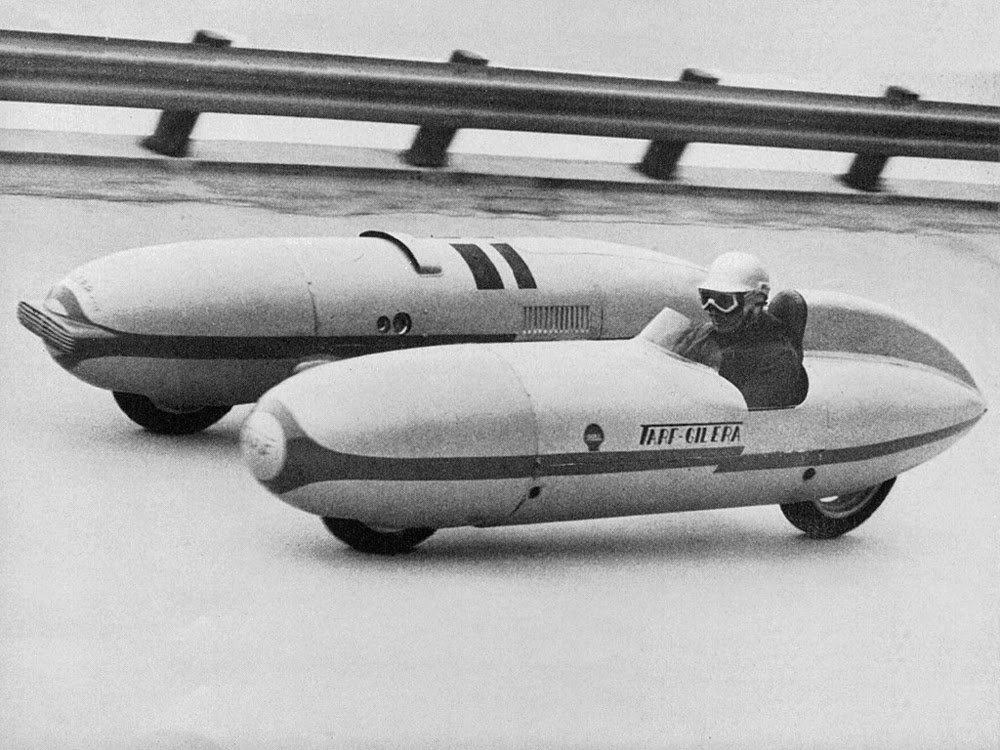 Tarf I at speed.
Instead, he refined his vision in the Tarf II, which reversed the placement of the driver and engine. This version included adjustable rear fins to compensate for wind direction—an early take on aerodynamic tuning—and ditched the traditional steering wheel in favor of dual levers, one on each side of the cockpit. The gearbox and clutch were operated by hand levers positioned between the driver's legs, while braking was handled hydraulically on all four wheels. Most significantly, the Tarf II was equipped with a 1.7-litre Maserati four-cylinder engine, enhanced by a two-stage supercharger that delivered 270 horsepower—more than five times the power of its predecessor.
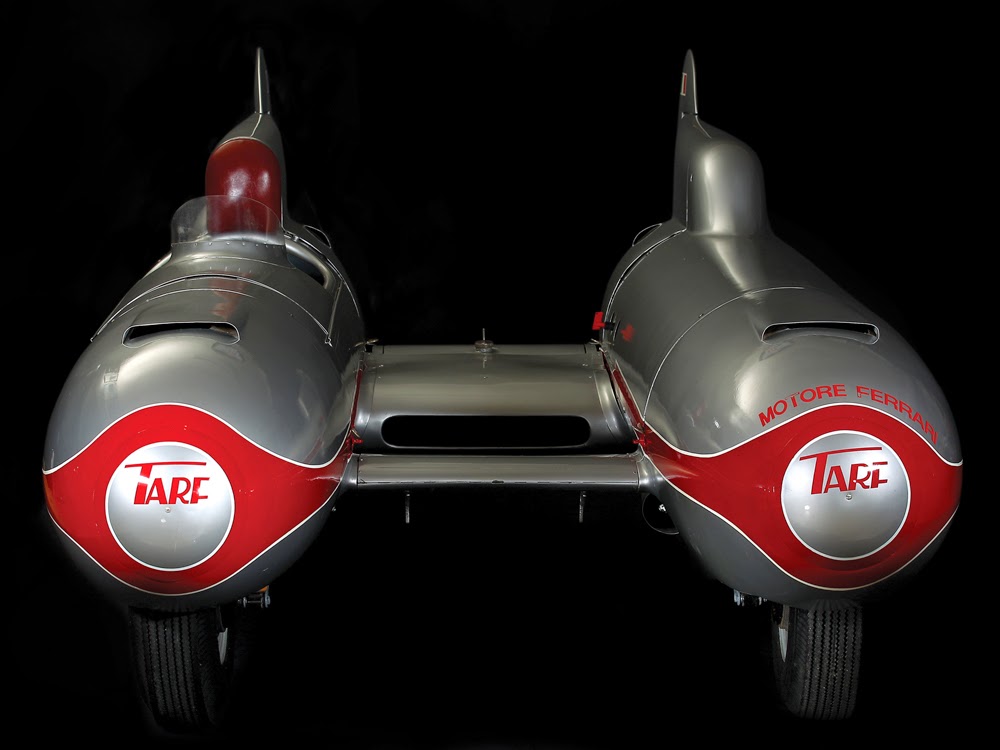 Tarf II, cockpit is on the right hand torpedo
The Tarf II made an explosive debut in March 1951, immediately setting two world records for the flying mile and kilometre with speeds of 185.5 mph (298.5 km/h) and 180.5 mph (290.5 km/h), respectively. In January 1952, it went on to break four additional speed records:
50 km – Average speed of 140.9 mph (226.7 kph)
100 km – Average speed of 139.7 mph (224.8 kph)
200 km – Average speed of 136.6 mph (219.8 kph)
One-hour run – Average speed of 135.1 mph (217.4 kph)
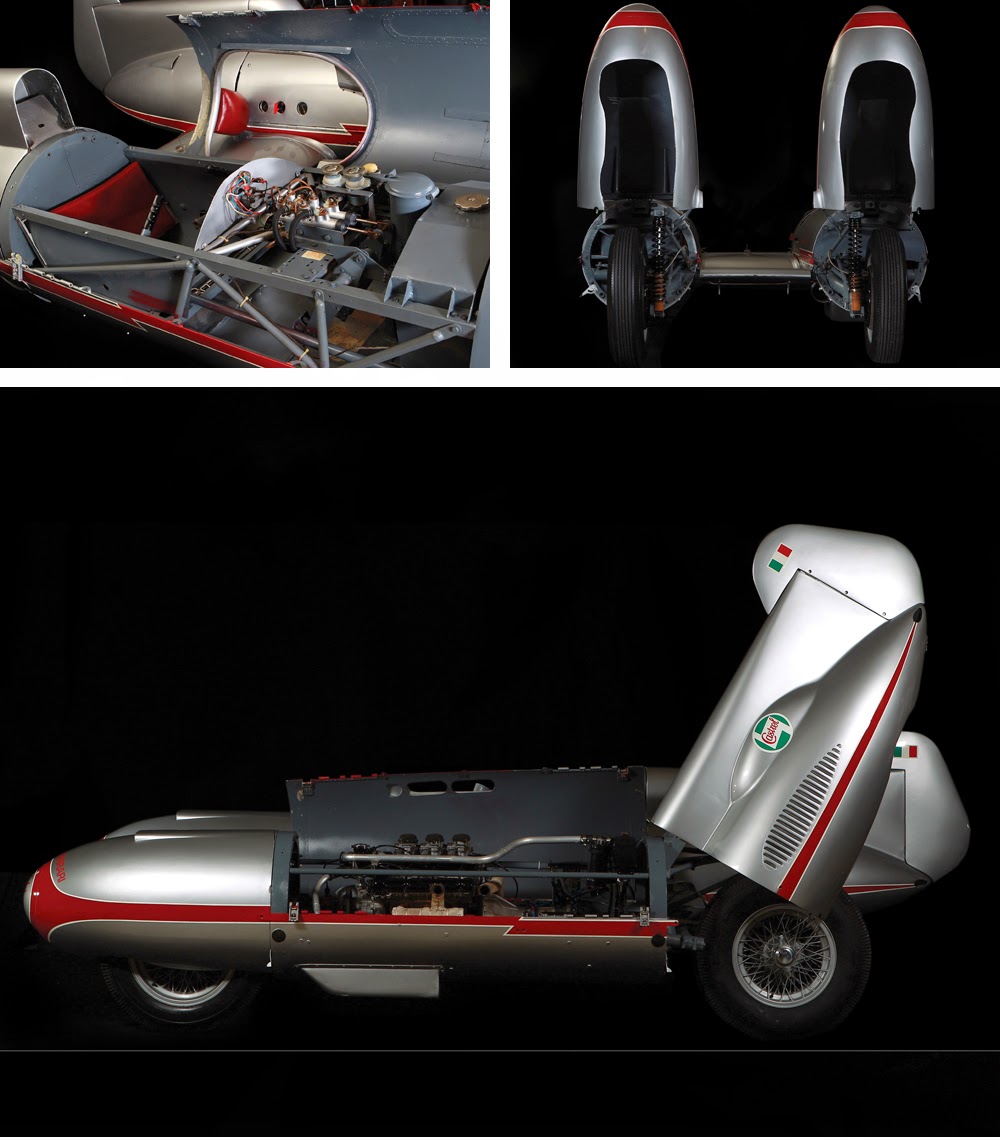 Tarf II. Note the rear fins.
These achievements firmly established the Tarf as one of the most advanced and effective land speed machines of its time. Taruffi had dreams of taking his radical design even further; a Tarf powered by a 4.5-liter Ferrari engine, intended for competition in the Indianapolis 500. That car was never built.
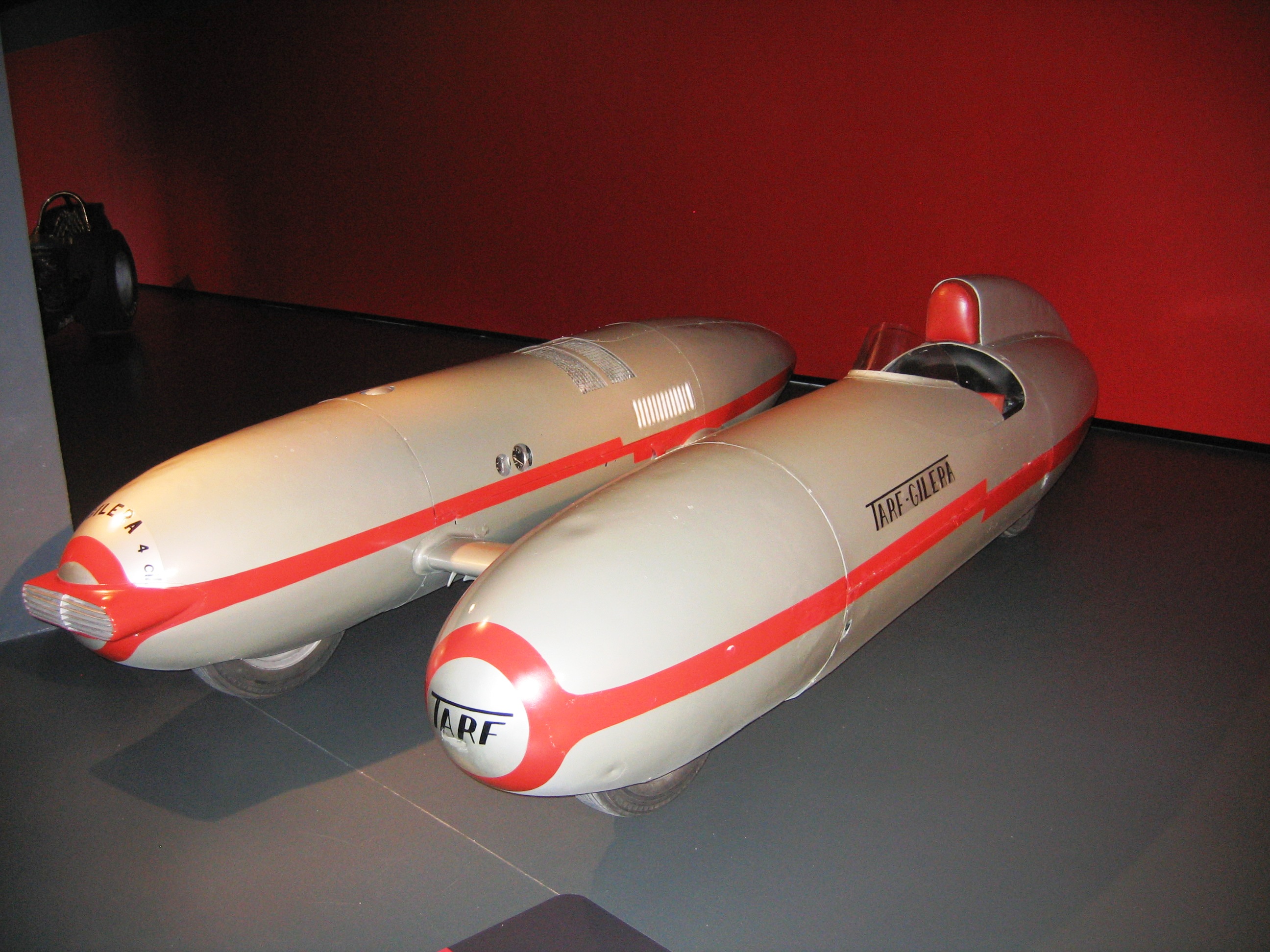 Tarf I at the Turin National Automobile Museum
Reflecting on his creation, Taruffi once said: “The importance of my car is that it embodies many new principles that will become standard in automobiles ten years from now.” While the twin-torpedo layout never became mainstream, many of the ideas—independent suspension, lightweight materials, aerodynamics, and alternative control layouts—have shaped the development of high-performance vehicles in the decades since.
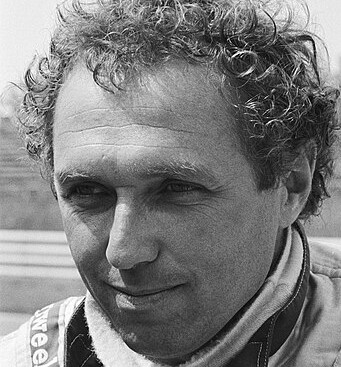 Vale: Jochen Mass, German F1 Driver. (30/9/46 - 4/5/25)
New Additions: May 2025
Welcome to the May update. A couple of parcels from Spark were delivered in April to finally break the two month drought. The first one contained just 1:5 helmets, mostly from the 2023 F1 season with one from the 2022 GT3 series. The second parcel had a bit of everything including a couple of models that are worthy of a special mention ...
The 1992 Tooheys 1000 was a sad occasion as popular veteran driver and 1967 Formula One world champion Denny Hulme, 56 years old from New Zealand, died of a heart attack suffered during lap 33. Hulme, driving the second Benson & Hedges Racing BMW M3 with Paul Morris, started the race in 18th position. On lap 33 when the race was under heavy rain, Hulme radioed to his team while coming through Forrest's Elbow that he could not see. Coming down Conrod Straight, the yellow #20 BMW went off the track and glanced the wall on the left hand side before continuing across the track to the outside wall where the car came to a stop. While the race continued under the safety car, Hulme was removed from the car and taken by ambulance to Bathurst Hospital where he was later pronounced dead from heart failure. The Hulme/Morris BMW has been reproduced by Spark with the full B&H livery.
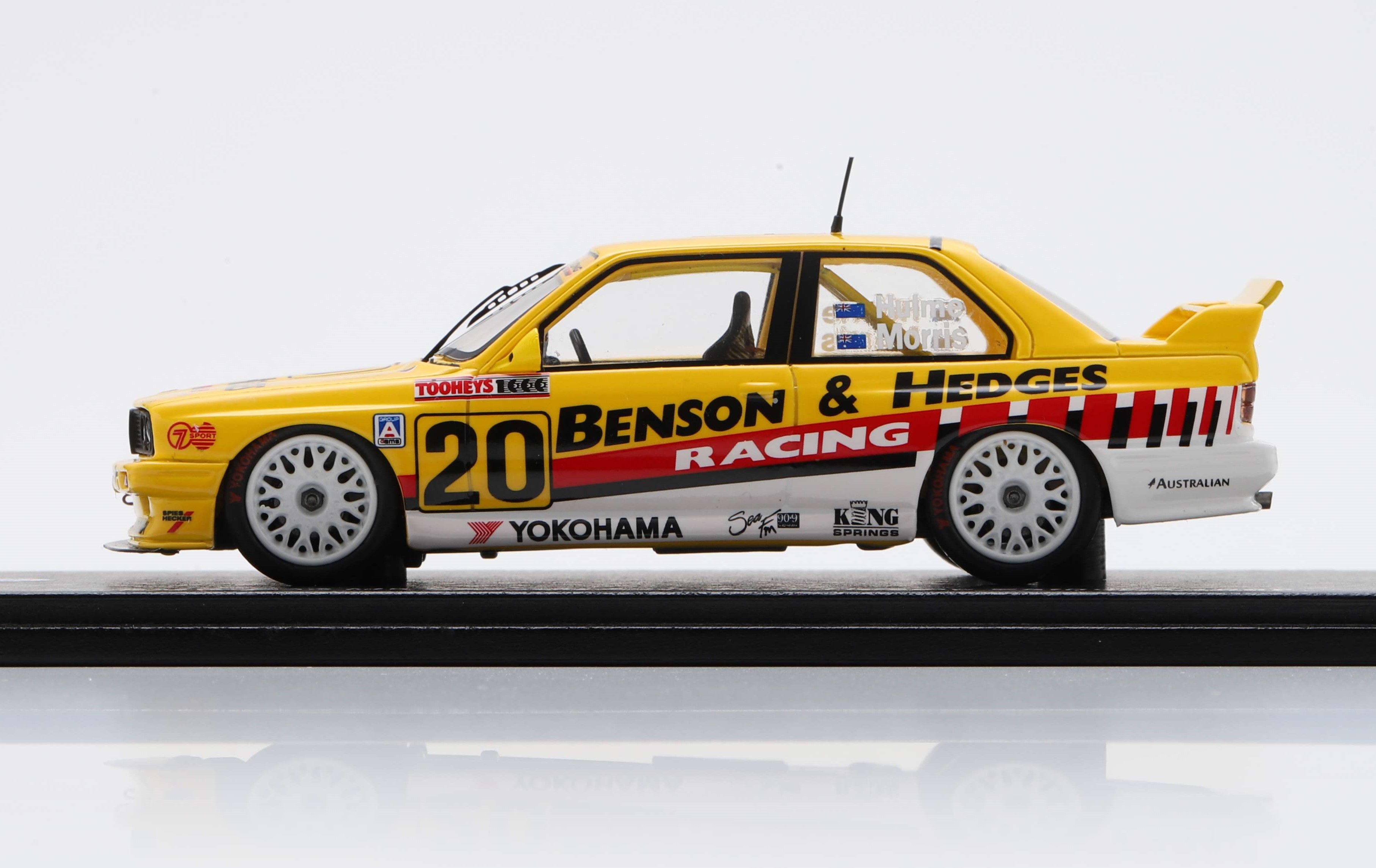 Spark: BMW E30 M3 1992 Bathurst 1000 (AS014)
After returning to sports car racing in 1995, Nissan Motorsport (Nismo) had some success with the Skyline GT-R LM which had competed in the GT1 class. However, these cars were soon outpaced by the influx of new manufacturers who were using loopholes in the GT regulations to build racing cars that bore little resemblance to their GT1 class competitors, examples being the Mercedes-Benz CLK GTR and the Porsche 911 GT1. The Skyline GT-R therefore needed to be replaced with a purpose built racing car. Nismo turned to Tom Walkinshaw Racing (TWR) to develop a prototype to be called the R390 GT1 using a twin-turbocharged 3.5-litre V8 engine. The car's styling team was led by Ian Callum from TWR. Nismo and TWR also had to build at least one road legal version of the R390 GT1 in order to meet homologation requirements. Only one road legal R390 was built, which is currently in storage at Nissan's Zama, Kanagawa facility. This beautiful road car has been released by Spark, a must have for Nissan fans.
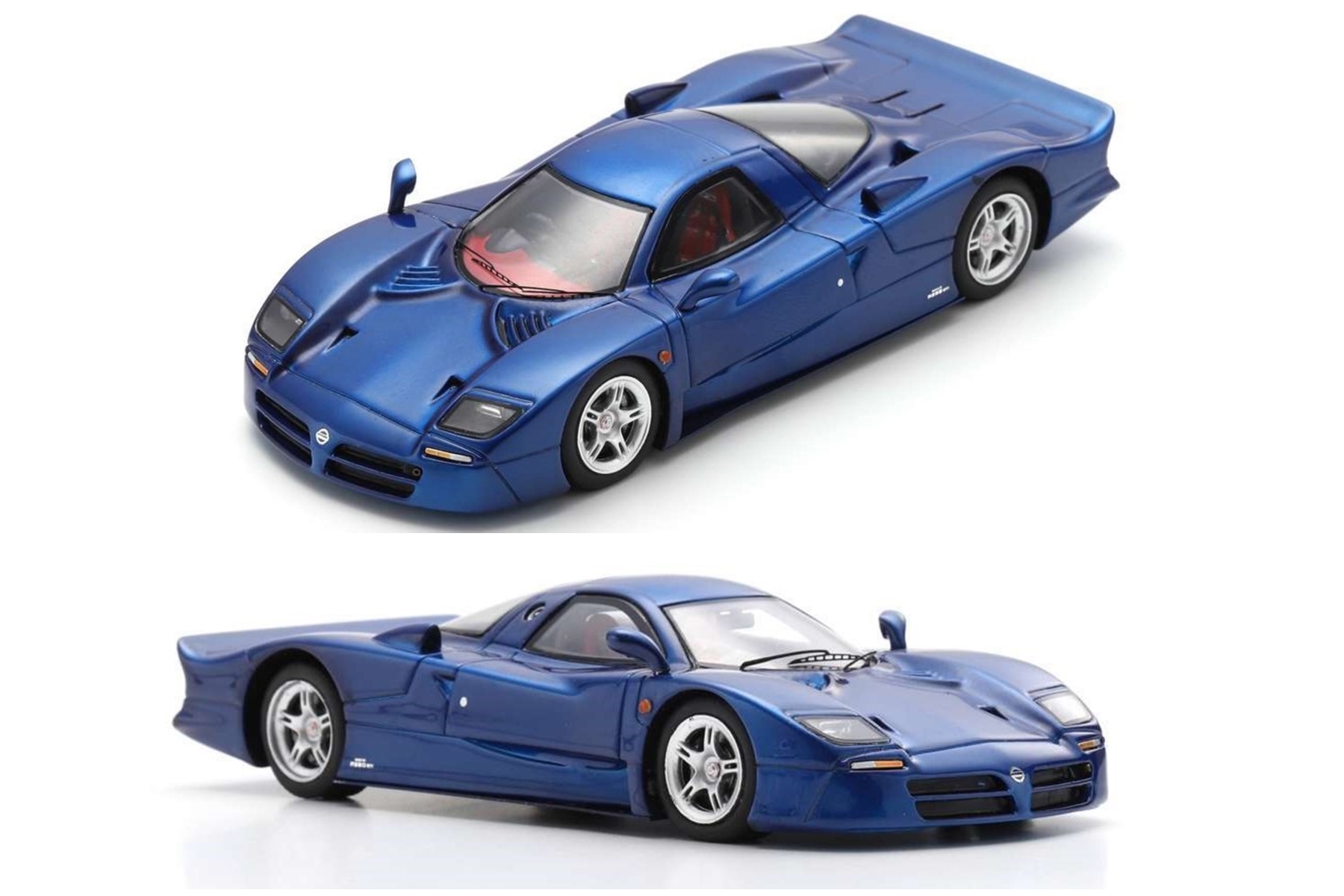 Spark: Road version Nissan R390 GT1 (S3634)
OK that's it for another month, so what's on in May? There's a couple of shows starting with the regular first Friday of the month Sydney Toy and Hobby Fair on 2nd May at the Epping Creative Centre, 26 Stanley Road, Epping starting at 6:30pm. I will also be attending the Collector Con Penrith on 25 May at the Penrith Valley Regional Sports Centre, 30 Herbert Street, Cambridge Park starting at 9:30am. Until next month, happy collecting.
Formula One
- 2023 Alpha Tauri RBPT AT04, L.Lawson (40) 9th Singapore GP (Spark)
Australian Racing Series
- 1992 BMW E30 M3, Hulme/Morris (20) 'B&H Racing' Bathurst 1000 (Spark)
- 2023 Chevrolet Camaro, Van Gisbergen/Stanaway (97) 1st Bathurst 1000 (Biante)
- 2023 Porsche 911 GT3 Cup, C.Hedge (17) Porsche Carrera Cup Aust Champion (Spark)
American Racing Series
- 2020 Lexus RC F GT3, Montecalvo/Bell/van Gisbergen/Telitz (12)Daytona 24H (Spark)
- 1973 Porsche 917/10 Turbo, H.Wiedmer (4) Can-Am Mosport 2nd (Spark)
Le Mans / Sports Cars
- 1968 Ford GT40, Hawkins/Hobbs (5) BOAC 6 Hours 4th (Spark)
- 2021 Porsche 911 GT3 R, Campbell/Bamber/Jaminet (22) 1st Paul Ricard 1000 (Spark)
Road Cars
- 1998 Nissan R390 GT1 in metallic blue (Spark)
Helmets (1:5)
- 2023 F.Alonso Japanese GP (Aston Martin) (Spark)
- 2023 V.Bottas Australian GP (Alfa Romeo) (Spark)
- 2023 V.Bottas Monaco GP (Alfa Romeo) (Spark)
- 2023 P.Gasly (BWT Alpine) (Spark)
- 2023 K.Magnussen Miami GP Haas F1 (Spark)
- 2023 K.Magnussen Monaco GP Haas F1 (Spark)
- 2023 L.Norris Miami GP (McLaren Team) (Spark)
- 2023 L.Norris Monaco GP (McLaren Team) (Spark)
- 2023 L.Norris (McLaren Racing) (Spark)
- 2023 E.Ocon (BWT Alpine) (Spark)
- 2023 E.Ocon Miami GP (BWT Alpine) (Spark)
- 2023 E.Ocon Monaco GP (BWT Alpine) (Spark)
- 2023 O.Piastri Monaco GP (McLaren) (Spark)
- 2023 O.Piastri (McLaren Racing) (Spark)
- 2022 L.Vanthoor 2022 Nürburgring 24 Hr (Manthey) (Spark)
After Thoughts: "Formula One Team Owner Shot Dead in Gun Battle with Police."
It sounds like the plot of a pulp-fiction novel but in fact is a true story, worthy of re-telling. A man of many names, Klaus Walz appeared to be the saviour that Gerard Larrousse so desperately needed for his financially beleaguered Formula One team. But, he emerged as an extremely nasty criminal and serial killer whose short-lived ownership ended when he was shot dead after a shoot out with German police.
Gerard Larrousse's troubled F1 team was riding on the crest of a wave, at the end of 1990 season they finished 6th in the Constructor's Championship. The next season they lost the Lamborghini V12 engine and had to use the outdated Cosworth DFR V8 engine. The team scored only 2 sixth place finishes and team was again in severe financial difficulties, owing money to Lola (chassis supplier) and Hart (engine supplier).
For 1992, Larrousse's team got a new lease of life after convincing Venturi, a small French manufacturer of road-going supercars to take a 65% stake in the team. The team still struggled on track, with only one sixth place finish by mid-season. Venturi, realising their mistake in owning the team decided to pull the plug mid-year and sold its shareholding to an investment group called Comstock and it seemed the team's financial struggles were over. The man who headed Comstock was "Rainer Walldorf", a German businessman but unknown to Larrousse, his real name was Klaus Walz. Walz had had a short-lived international racing career, mostly in sports cars built by ToJ. He tried F2 but wasn't quick enough to qualify and disappeared from the racing scene until his return as the majority shareholder in the Larrousse team in 1992.
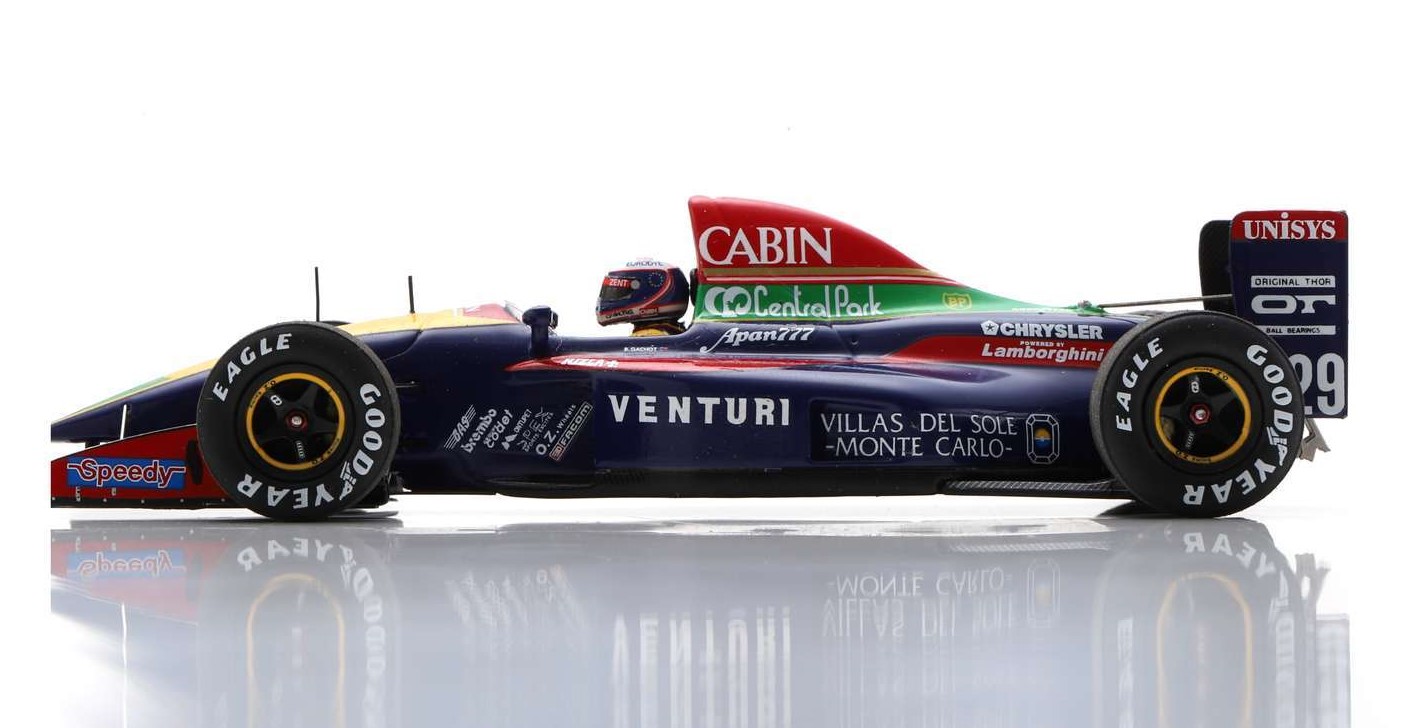 Spark: Venturi Larrousse LC92 (S6968)
But only a few weeks after the announcement of Comstock's ownership, Walz's tenure as a team owner was over. Walz's partner in the Comstock organisation was his nephew, Gordon Walz and the two of them were the masterminds behind a vast criminal network handling high-value cars stolen to order. The centre of this operation was a large workshop in northern Italy where the re-birthing of the stolen cars took place. After a dispute with one of the Italian mechanics, the two Walzs murdered the mechanic, who knew too much, by forcing him into the boot of a car and setting it alight. They eventually were forced to release him and instead shot him to silence his agonisng screams. By the time Comstock was involved with Larrousse, police had connected the Walzs with three other murders. According to Interpol, there was possibly a fourth murder and Klaus and Gordon Walz were high on the list of most wanted criminals. When French police noticed the Comstock name on the Larrousse LC92 F1 car they suspected a connection to Klaus Walz.
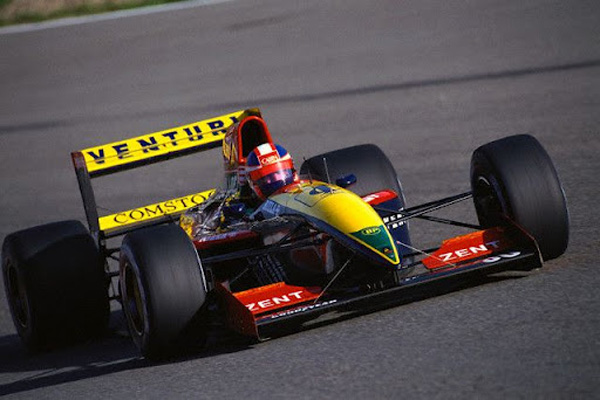 Larrousse LC92 with Comstock livery on rear wing
French police then tracked the pair to a villa near Nice and raided the house but incredibly the Walzs were able to escape from the inept police. The two fugitives then headed to Germany, but within a month German police had tracked them down to a Munich hotel. Learning from the mistakes of their French colleagues, the Bundespolizei had the hotel room surrounded while the Walzs barricaded themselves inside. After a nine hour stand-off, armed officers stormed in. In the ensuing gun battle, the younger Walz gave himself up while Kaus Walz shot himself dead.
So ended Klaus Walz's extremely short career as owner of a Formula One team through which he had planned to launder some of his illicit profits. The Larrousse teamed continued racing and battled on until 1995 when the team finally collapsed financially with Gerard Larrousse facing several lawsuits.
New Additions: April 2025
Welcome to the April update; it's going to be another short one with no new additions to report again. This will change next month, I promise! So, with no new additions, I thought I'd focus again on some models that were received earlier and deserved a mention.
The 1986 Indianapolis 500 was the 80th running of the great race. The 500 mile race was held on May 25, 1986, at the Indianapolis Motor Speedway. Bobby Rahal won the race, driving a March 86C-Cosworth for the Truesports team. Rahal's victory was his first at the Indianapolis 500 and he went on to win five more races during the 1986 CART season, eventually winning the championship. The Replicarz (R43034) March 86C #3 Budweiser is a high-quality 1:43 die-cast model that is perfect for any fan of Bobby Rahal or the Indianapolis 500. The model is accurate and detailed, and it is sure to be a prized addition to any Indy car collection.
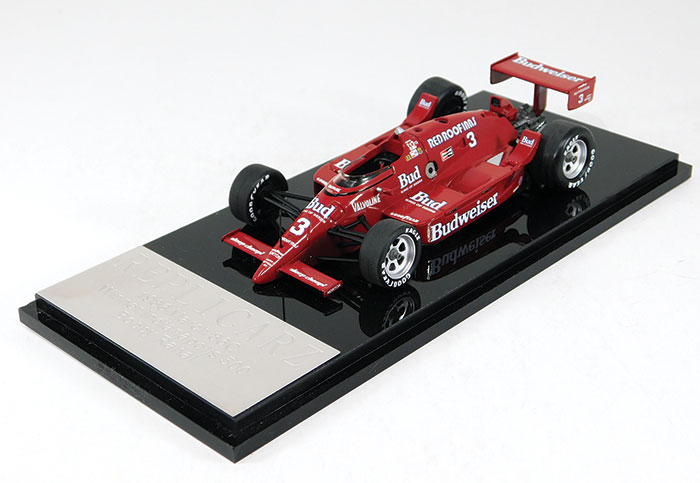 Replicarz: March 86C 1st Indy 500 1986
The 250 GT California Spyder was a sports car developed by Ferrari but was designed by Sergio Scaglietti, founder of Carrozzeria Scaglietti, an automobile design and coachbuilding company located across the road from Ferrari in Maranello. The Spyder, a convertible version of the Berlinetta was powered by a traditional Ferrari V12 engine and approximately 100 units were produced between 1957 to 1963. The model gained considerable recognition after its appearance in the 1986 film "Ferris Bueller's Day Off". Although the Ferrari 250 GT California Spyder was not specifically designed for competition, many models participated in endurance races. It won its class in the 12 Hours of Sebring in 1959, and again in 1960. The 1:43 model from Kess would be a welcome addition to your Ferrari or sports car collection.
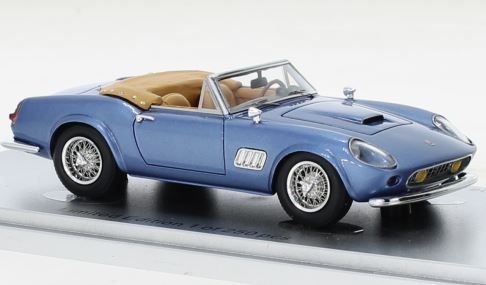 Kess: Ferrari 250GT California Spyder (KE43058002)
OK, that's another monthly update wrapped up. So, what's happening in April? The regular Sydney Toy and Hobby Fair is on 4th April at the Epping Creative Centre, 26 Stanley Road, Epping starting at 6:30pm and finishing around 8:00pm. There is a Collector Con on 27 April in Newcastle, but I will not be attending this event. That's it, another fairly quiet month for Toy Fairs, so until next month, happy collecting.
After Thoughts: "Unheralded F1 Driver Series #9 - Brian Redman."
Brian Redman is one of the greatest endurance and sports car racers of all time, with a career spanning multiple disciplines, including Formula One, endurance racing, and Formula 5000. His versatility, reliability and sheer talent made him a much sought-after driver in a career spanning over three decades.
Redman was born on March 9, 1937, in Lancashire, England and made his racing debut in 1959 with a Morris Minor Traveller that he had supercharged for speedy grocery deliveries while working for his father's grocery chain. The talented delivery driver eventually caught the attention of John Wyer in 1967 and was asked to join Jacky Ickx in their GT40 at Kyalami for the 9 Hour race. They won and Brian was signed up for a full-time drive. He also signed with Cooper to join their F1 team.
He was also approached by Ferrari for their F2 team. Following a test, he drove a Dino 166 in the Eifelrennen on the Nürburgring Südschleife. After a stone smashed his goggles and injured his eye, he made his way back to the pits only to be ordered to get back into the race with a new pair of goggles. From last and 2 minutes and 15 seconds off the lead, he finished 4th, breaking the lap record on the way. That evening he was offered a contract with the Scuderia for F2 that year and F1 in 1969. Redman famously turned them down.
His F1 debut was at the South African GP on January 1st, 1968 but was forced to retire his Cooper Maserati. In his next race he came third at the Spanish GP but then had a massive accident at Spa after a wishbone failure. The car vaulted the barriers and Redman suffered a serious break to his right forearm which required two steel pins. He was sidelined for the rest of the year and still has the two steel pins in his arm. By the end of his F1 career he had participated in 15 World Championship Grands Prix, driving for Cooper, Williams, Surtees, McLaren, BRM, and Shadow. Apart from his podium in 1968, he achieved two 5th places scoring a total of 8 championship points in a sporadic career spanning six years.
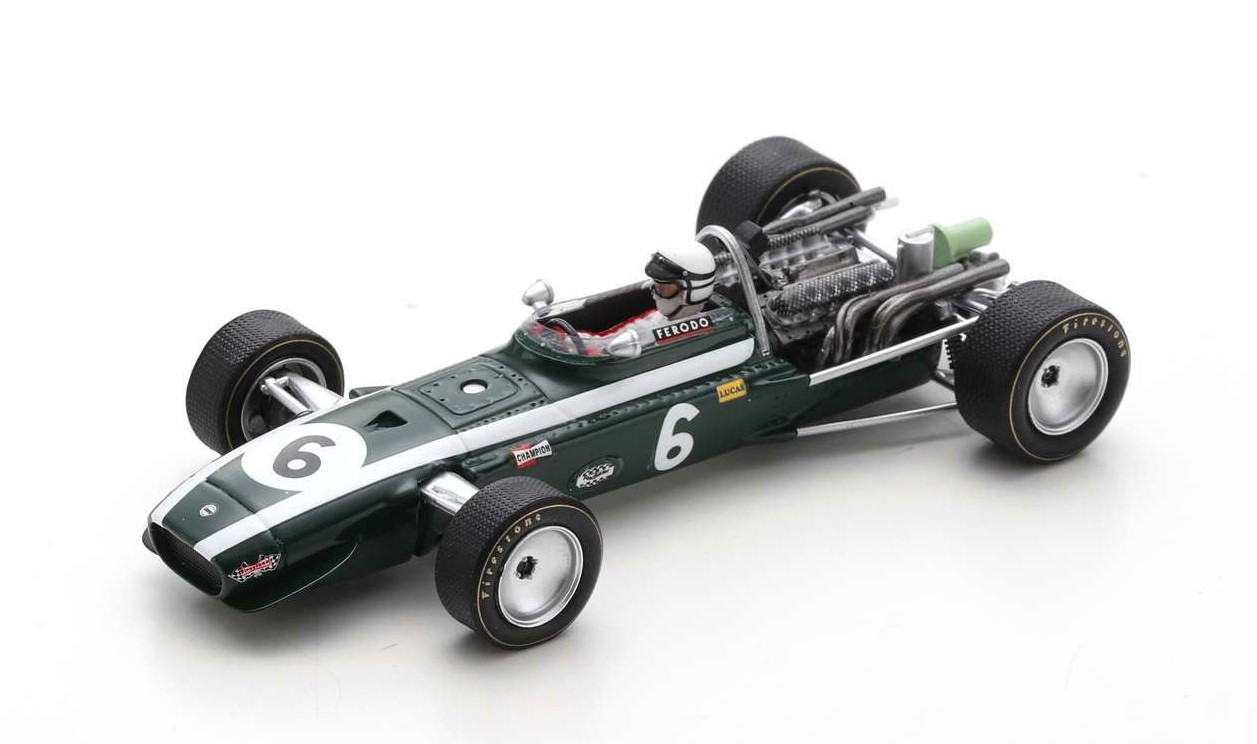 Spark: Cooper BRM T86B 5th Brands Hatch ROC 1968 (S6980)
In 1972 he was approached by Ferrari again and this time he signed to race the 312PB in long distance races. He was with them for two years, first with Regazzoni then partnering with Ickx. During his second year he started racing in F5000 in the USA. At the end of the year he left Ferrari and moved to the States where he became very successful with Jim Hall and Carl Haas, winning the US F5000 title three years running, in 1974, 1975 and 1976. He also achieved spectacular success in sports-car racing driving for various teams, his key achievements included:
- Spa-Francorchamps 1000 km: 5-time winner.
- Nürburgring 1000 km: 3-time winner.
- 12 Hours of Sebring: 2-time winner.
- 24 Hours of Daytona: 2-time overall winner.
- Targa Florio (1970): Overall victory.
- Monza 1000km, Brands Hatch 6 Hrs, Österreichring 1000km, Kyalami 9 Hrs: Multiple wins in each.
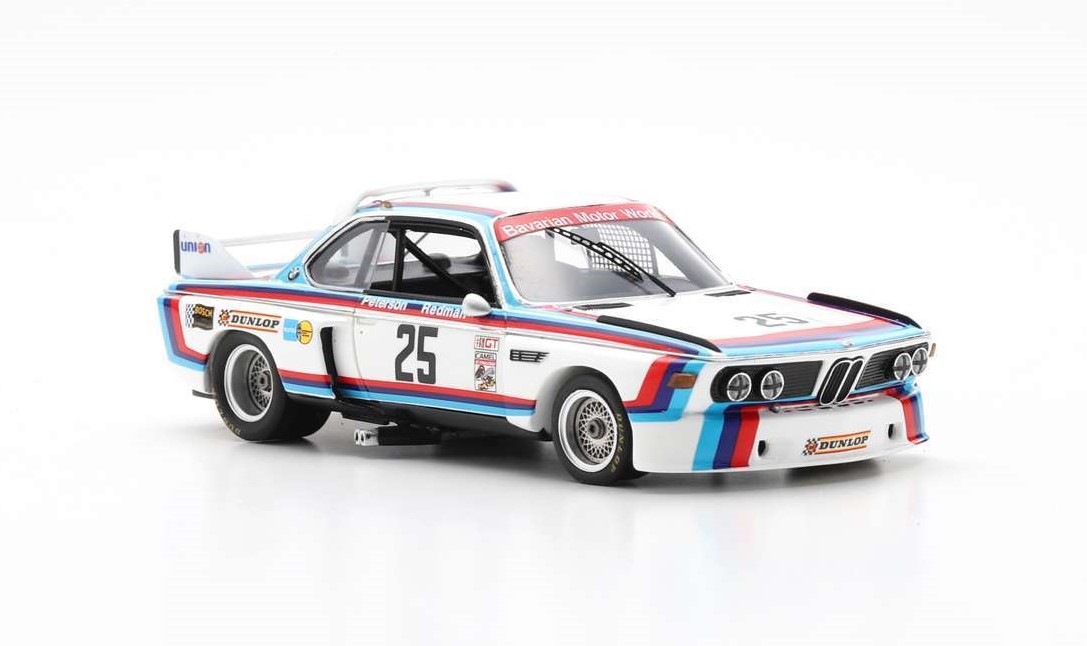 Spark: BMW 3.0 CSL 1975 1st Sebring (43SE75)
His stellar career nearly ended in 1977. During practice for the Can-Am race at Circuit Mont-Tremblant, his car launched 40 feet into the air at 160 mph, flipped, and landed upside down. He suffered a broken neck (C1 vertebra), fractured shoulder, sternum, and brain bruising. So severe were his injuries that he was declared dead at the scene but miraculously survived and made a full recovery. Redman returned to racing in 1978 and promptly won the Sebring 12 Hours in a Porsche 935.
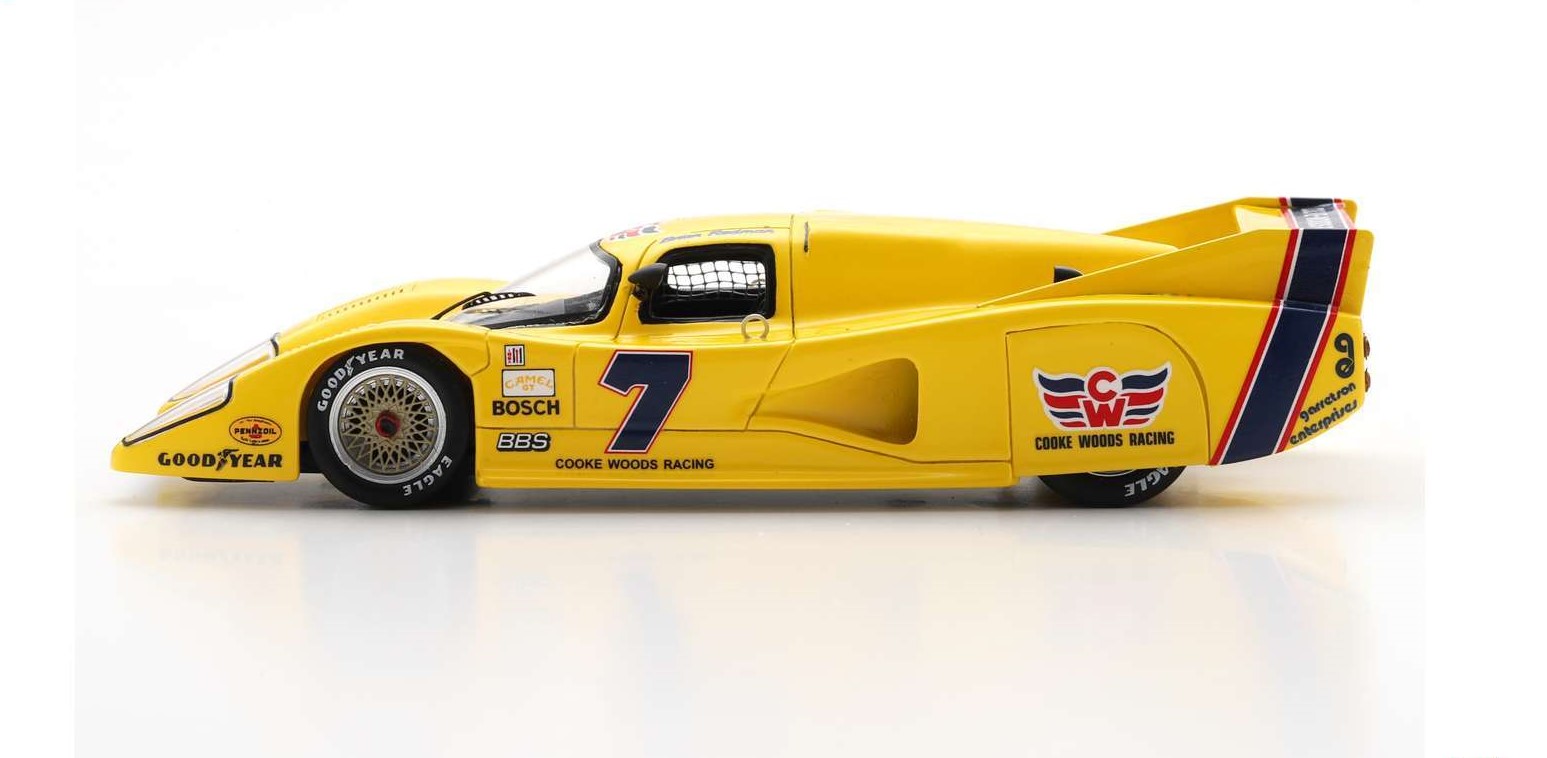 Spark: Lola Chevrolet T600 1981 1st Laguna Seca (S8601)
His racing career continued into his 50s, competing in IMSA, Jaguar’s Group 44, and Aston Martin’s factory-backed efforts. After retiring from professional racing he remained active in historic motorsport events as a promoter and ambassador. While his F1 tenure was brief, he achieved an incredible record in sports car racing, with victories in nearly every major endurance event. Brian Redman fully deserves his status as one of motorsport’s true legends.
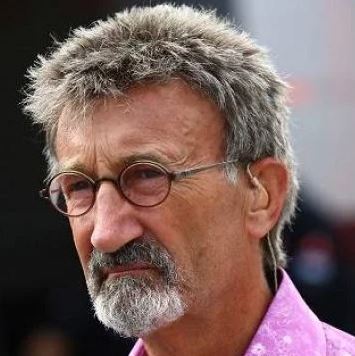 Vale: Eddie Jordan, F1 Team Principal. (30/3/48 - 20/3/25)
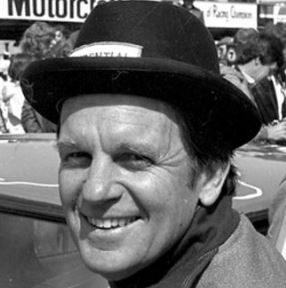 Vale: John French, Australian Touring Car legend (28/11/30 - 12/3/25)
New Additions: March 2025
Welcome to the March update; it's amazing that we are already two months into 2025. I always look forward to March as many motor racing series start their championships. The first round of F1 begins in Melbourne on the 16th March and the attention will be on the "local" drivers Piasti, Doohan and Lawson. The Indy Cars kick off on 2nd March around the streets of St. Petersburg where we'll be cheering on the Antipodeans McLaughlin, Power, Dixon and Armstrong. The NASCAR Cup series has already completed two races with Van Gisbergen sitting in 34th position and the Australian Touring Car Championship roared into action on 21st February. The WEC held their first race on 28 February and lastly the MotoGP revs up on 2nd March at the Thai GP with Aussie Jack Miller riding a Yamaha. Ok, enough about motorsports now onto model cars; actually there is very little to report only that there are no new additions this month!!
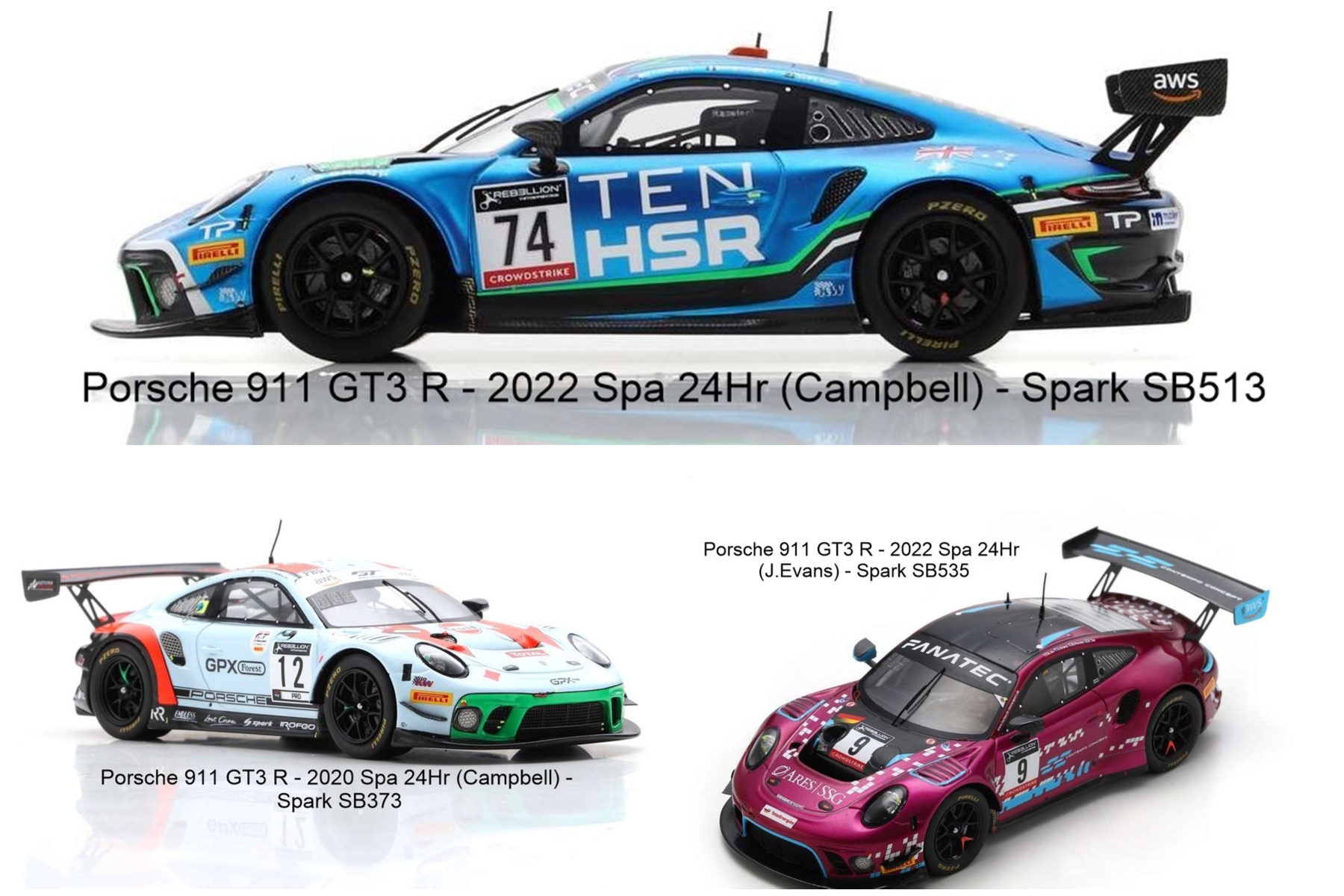
With no new additions for March, I thought I'd revisit last month and focus on some models that I didn't but should've highlighted. Firstly, the three works Mazda R100's that raced at Spa in 1969 are featured in the "After Thoughts" section below. Finally, some photos of the Porsche 911 GT3 R's that were raced by Aussie and Kiwi drivers at the Spa 24 Hour races.
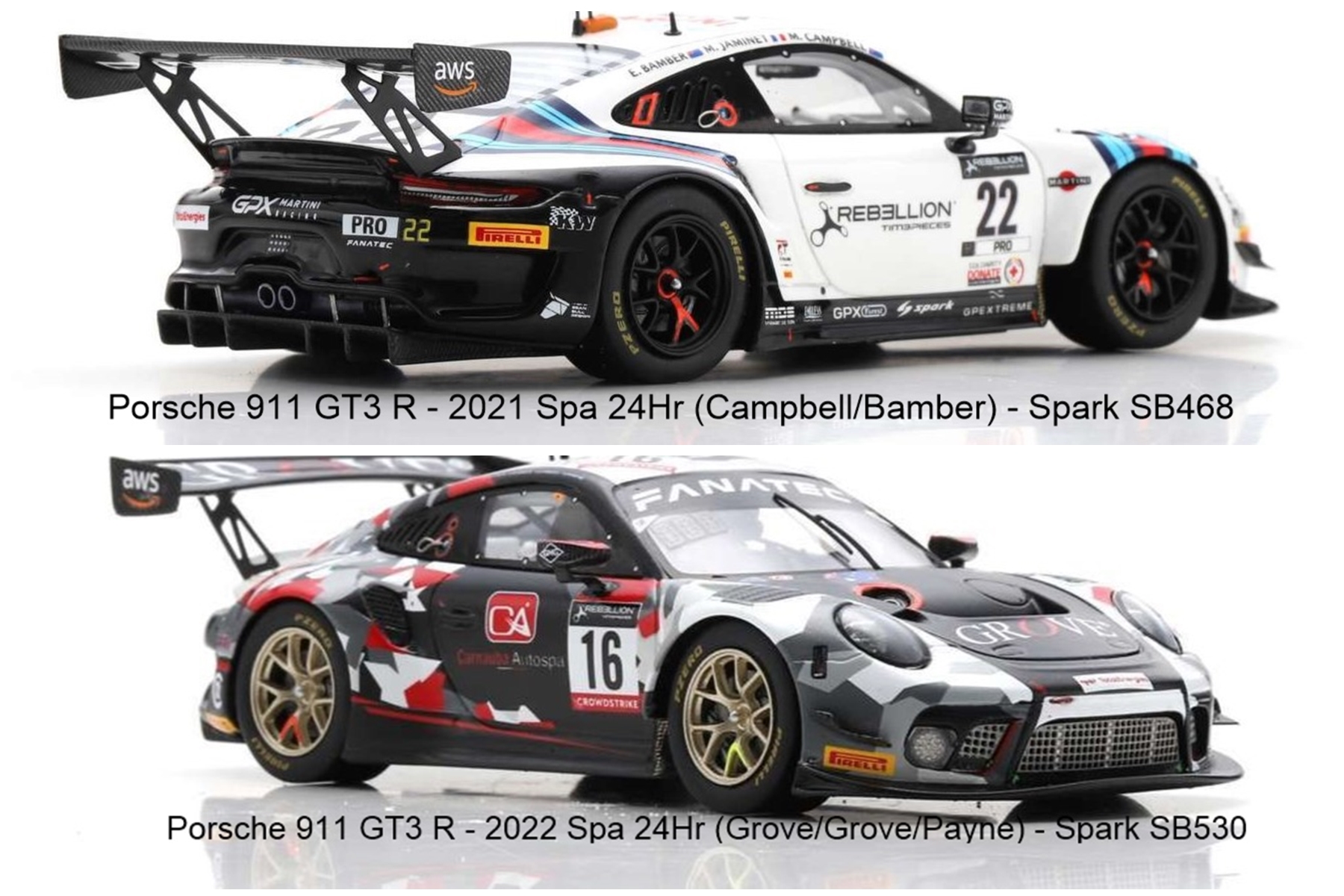
Well, that's another monthly update done and dusted. What's on in March? The regular Sydney Toy and Hobby Fair is on 7th March at the Epping Creative Centre, 26 Stanley Road, Epping starting at 6:30pm. The first Collector Con for the year will be on 30th March but I won't be attending this event. Also, I've had a few dates confirmed; the Hawkesbury Model and Hobby Show will be held on 20/21 September and the Shannons Sydney Classic is scheduled for 17th August. The Diecast Model Expo (organised by Motorfocus) will be held in Melbourne again this year on the weekend of 19-21 September while the Australian Diecast Expo 2025 (organised by Southern Diecast) will be in Adelaide on the weekend of 15-16 November. Ok, you are now up-to-date with what's going on in the model car world, until next month, happy collecting.
After Thoughts: "The Mazda R100 at the 1969 Spa 24 Hour"
Mazda’s rich pedigree in motorsport started back in the 1960's when Mazda’s engineers took on the challenge of making the rotary a viable alternative to regular piston engines. The smooth, free-revving and extremely compact Wankel engine offered a far superior power-to-weight ratio to conventional piston engines and the unmatched simplicity of a combustion cycle which required only one moving part. On the minus side the rotary didn’t mind a drink and its exhaust emissions were high, but in the 1960's such concerns were of little importance.
Having overcome the challenges that perplexed rival NSU, they then needed to prove the rotary technology on the world stage and so Mazda chose the toughest test of all, the 1968 Marathon de la Route. This was an epic 84-hour endurance race around the famously challenging Nürburgring circuit in Germany. After success in the 1968 Marathon de la Route with the Cosmo Sport [see After Thoughts October 2023], Mazda decided to enter the world famous Spa 24 Hour race in 1969.
A critical step for Mazda in its bid for global acceptance of the rotary was to install one in a normal passenger car, which could be mass-produced in series production.The donor model chosen was Mazda’s humble 1200 coupe, which was renamed the R100 with the ‘R’ denoting its rotary engine and the ‘100’ indicating its impressive horsepower output. On reflection, the R100 was in effect a production prototype for the high performance rotary powered ‘RX’ models which would soon follow. For the Spa 24 Hour three R100 coupes were entered by the factory.
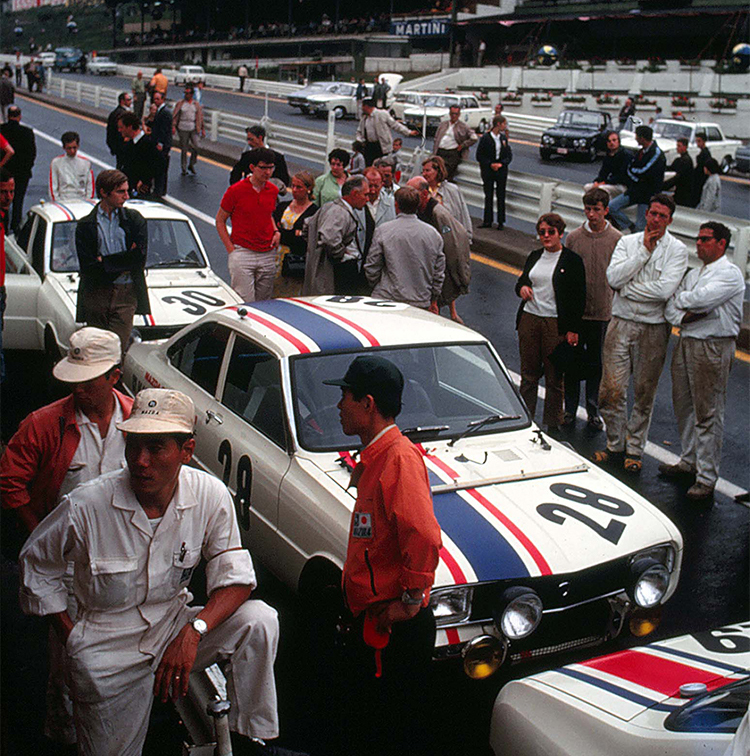
The R100’s twin-rotor one-litre engine produced 200bhp at 9,000rpm, while the unsilenced noise of the rotary engine left European fans in no doubt about the unique engine under the bonnet. With only 805 kg to propel, the swoopy fastback could clock the standing quarter in less than 18 secs with a top speed of 110 mph (175 km/h). However the R100 wasn’t as composed through the corners. It was very narrow and tall relative to its length, resulting in lots of body roll and some fearful roll oversteer at high speeds.
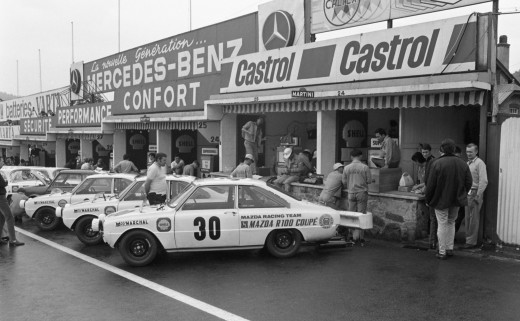
With a history dating back nearly as long as Le Mans, the Spa 24 Hour was a prestigious event in the European calendar and the ultimate test of racing cars representative of products customers could buy in showrooms. Held on the ultra-fast and dangerous 14km Spa Francorchamps circuit, the R100's competition came from a huge multi-class grid comprising of BMWs, Lancias, NSUs, Gordinis, Minis, Alfa Romeos and Porsches. It was assumed the outright fight would be between the thoroughbreds from Porsche and BMW.
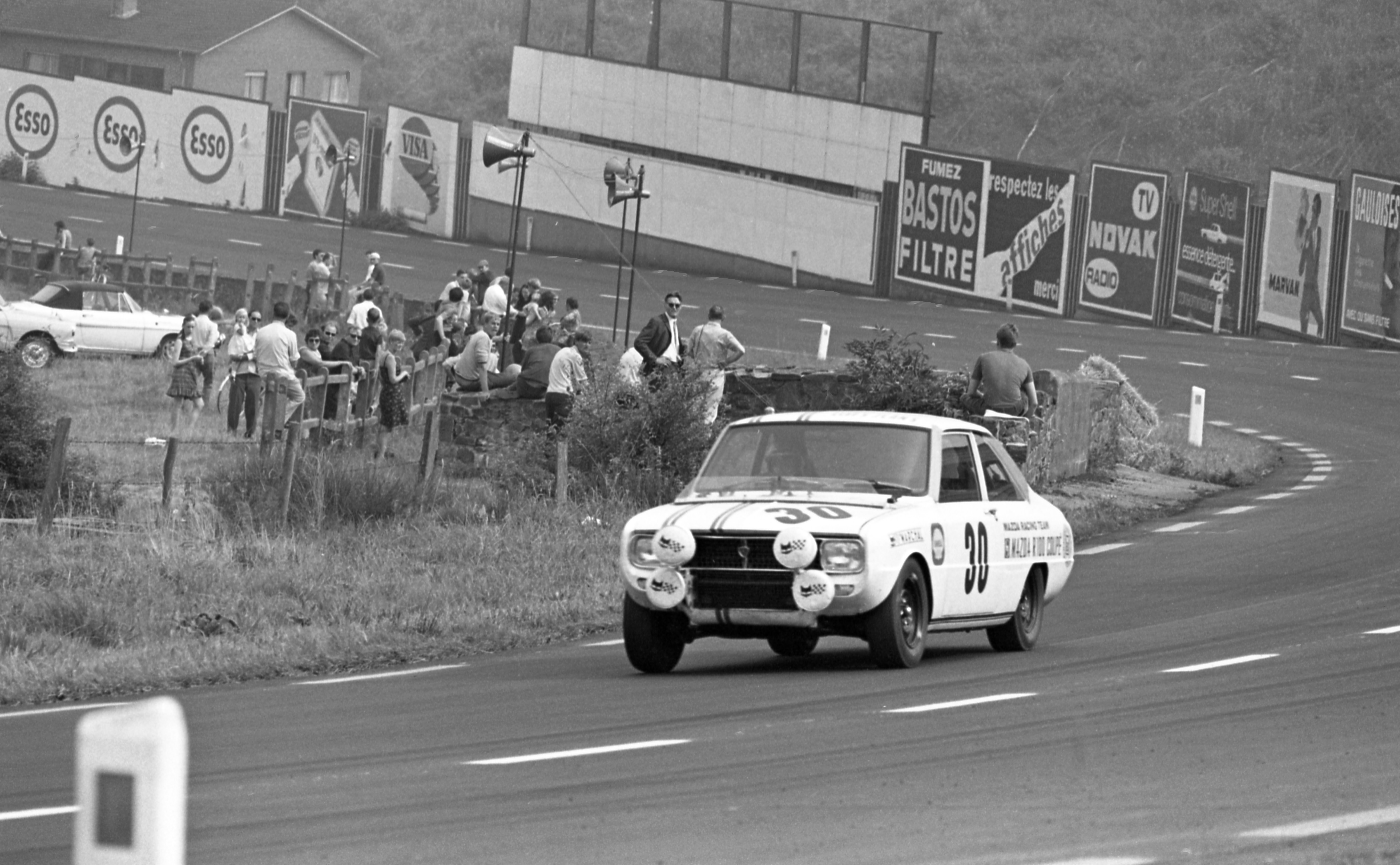
After the BMW challenge faded the factory-backed Porsche 911s finished a resounding 1-2-3-4, but what most observers had not expected to see after 24 hours were two of the Mazda R100s nipping at their heels in fifth and sixth. The third Mazda had been eliminated in an accident earlier in the race that tragically claimed the life of Mazda driver Leon Dernier.[1] In an astonishing first-up display of twice-around-the-clock durability, the little rotary-powered rockets just kept going and going, displaying competitive speed and faultless reliability while many of their piston-engined rivals fell around them. From that point on the R100 was known as the “Little Giant” in Europe.
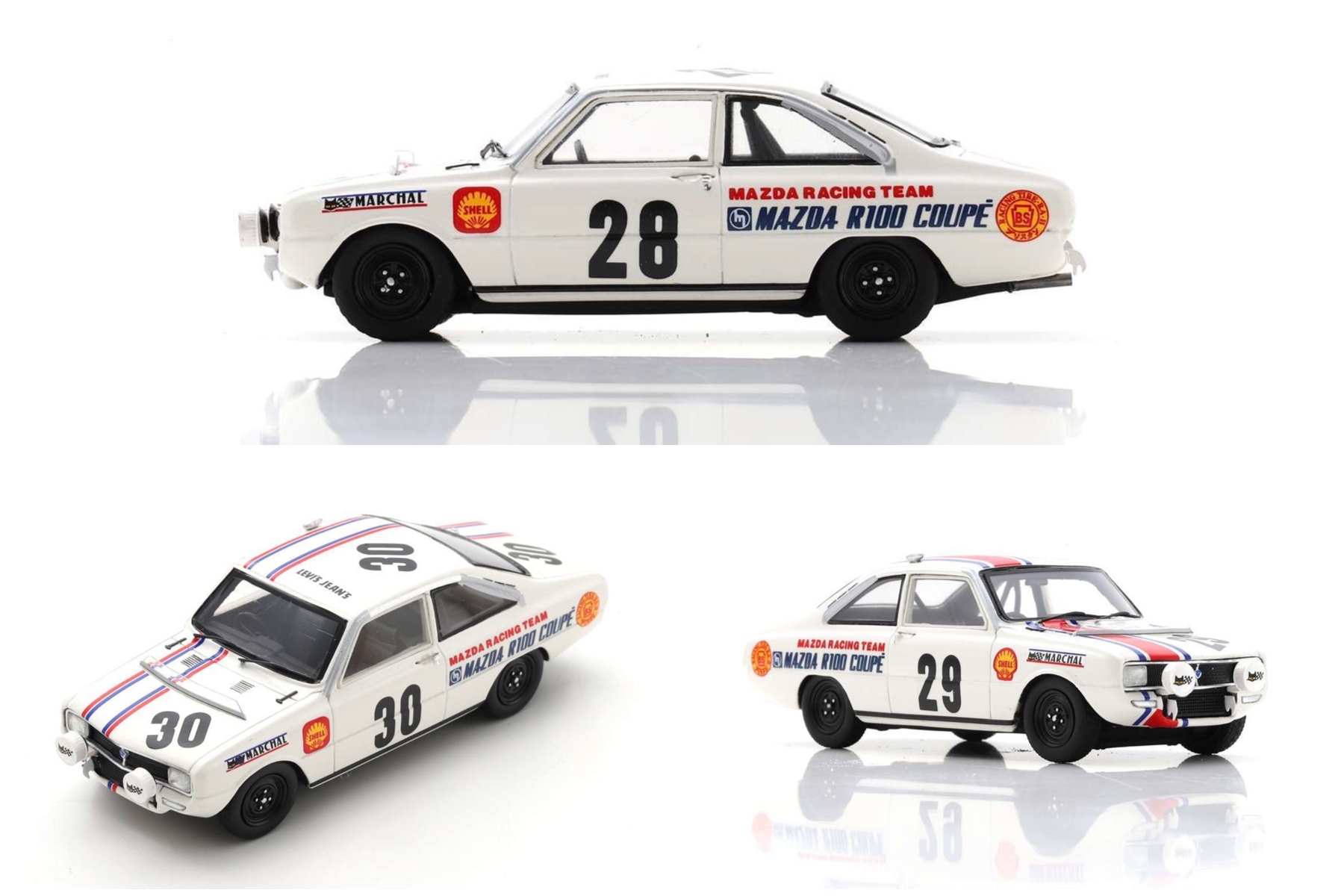 Spark models: Works Mazda R100 Coupes at Spa 1969
Note 1: Leon Dernier competed under the racing name of Eldé, probably because "dernier" means "last" in French, he was 57 year-old.
New Additions: February 2025
Welcome to another monthly update. January is always a slow month with many people taking their summer holidays but now we are truly into the new year and we can start to get excited about model cars again! A nice shipment of Spark models arrived last month, consisting mainly of Porsche 911 GT3's that raced at the Spa 24 hour by various Australian and NZ drivers and also some interesting rotary Mazdas that raced in 1969. In addition, some road cars by Kess and Goldvarg were also received as well a beautiful Camaro from TSM. Here are a couple of my highlights.
The Brabham BT23C that Jochen Rindt tested at the F2 Albi GP in 1968 was reminiscent of the early days of powered flight when men flew in contraptions of fabric and wood, lashed together with a healthy dose of optimism. The story of the BT23 started in 1967 when it was designed as a Formula two racing car, although some cars were later converted for F1 by private drivers. A revised version, the BT23C was put into production for the '68 F2 season and an early adopter was Roy Winkelmann Racing. The Winkelmann squad were in at the start of F2 back in 1964 and they had signed a new talented driver by the name of Rindt in 1965. The late '60's through to the early '70s was a period where designers and engineers sought to understand the aero effects on their cars so Rindt's BT23C sported a mid-mounted 'biplane' wing for a test session at the '68 Albi GP. Rindt won six races (without the wing) and dominated the 1968 F2 season. Spark has produced this weird and wonderful car in the Winkelmann Team racing colour of dark green, with its distinctive silver nose and stripe (SF251).
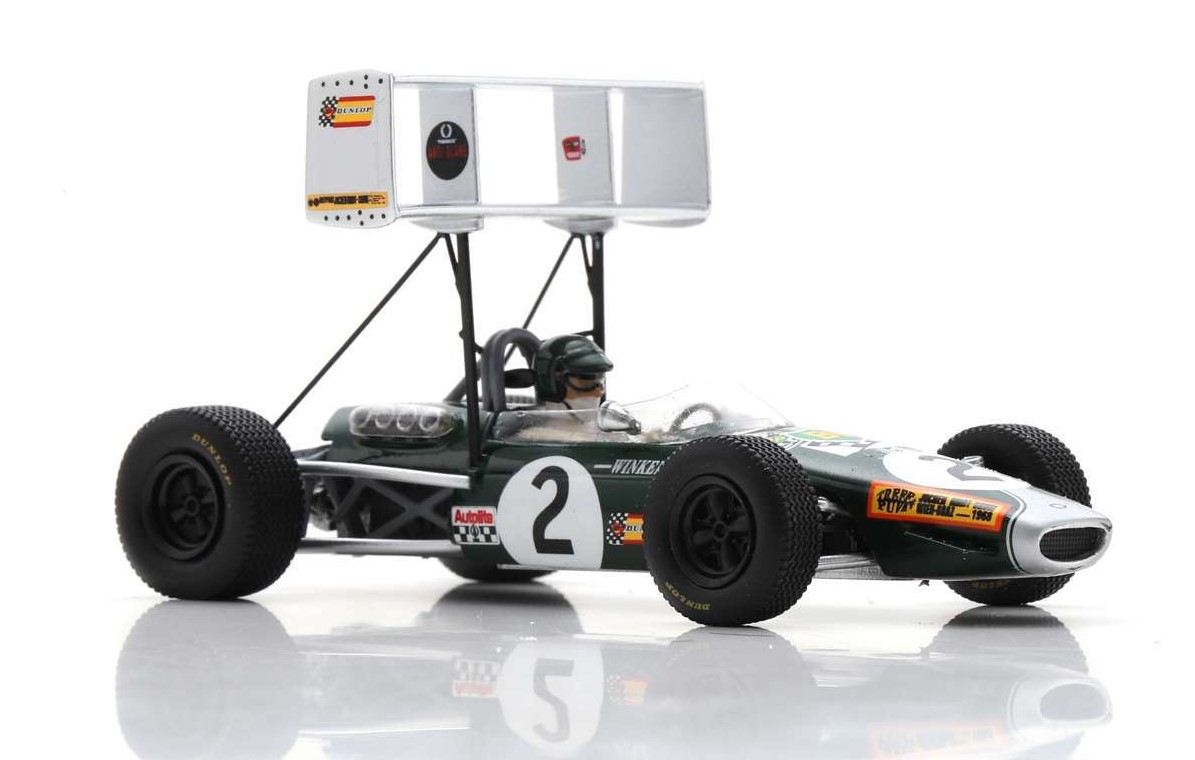 Spark: Brabham BT23C test at the '68 F2 Albi GP
After being absent for two years, Garage 56 returned to Le Mans in 2023. The Garage 56 concept is to allow the testing of new automotive technologies and in 2023 a modified Next Gen Chevrolet Camaro ZL1 NASCAR fielded by Hendrick Motorsports was chosen to compete in the "Innovative Car" class. The Camaro ZL1 received numerous aerodynamic updates, carbon brake discs, functional front and rear headlights, and a larger fuel cell, which reduced its weight by 238 kg compared to the NASCAR Cup Series model. Mike Rockenfeller, the 2010 Le Mans co-winner, joined 2009 F1 World Champion Jenson Button and seven-time NASCAR Cup Series champion Jimmie Johnson as the drivers. After 20 hours of trouble-free running, the Camaro was ahead of the entire LMGTE field but then suffered a drive line issue which required over an hour in the pits to repair. Ultimately the team finished in 39th place out of 62 cars that started. TSM has produced this interesting model in both 1:43 and 1:18 scales and they have also produced a "raced" (dirty version) in both scales. These are high quality sealed resin cast models.
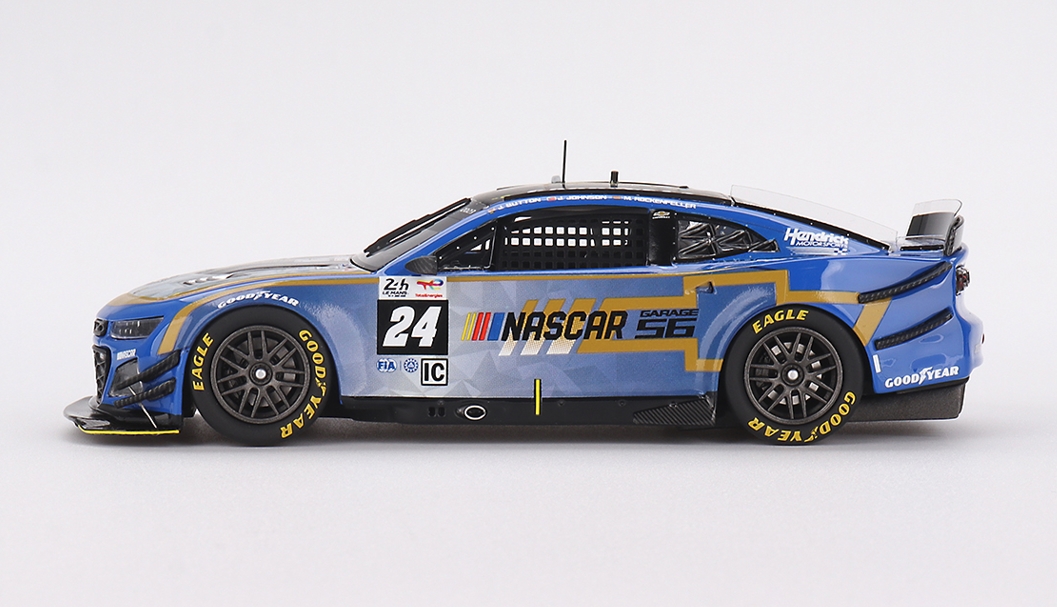 TSM: Camaro ZL1 Le Mans 2023 (TSM430793)
OK, that's it for another month. Only one event is scheduled for February and it's the regular Sydney Toy and Hobby Fair on the 7th. It is held at the Epping Creative Centre, 26 Stanley Road, Epping starting at 6:30pm. Until next month, happy collecting.
Formula One/Two
- 1968 Brabham Ford BT23C, J.Rindt (2) Essais GP d'Albi F2
- 2023 Dallara Mugen SF23, L.Lawson (15) Japanese Super Formula
- 1970 Matra MS11-12, J.P.Beltoise (90) 1st course de Côte du Mont Dore
American Racing Series
- 1986 March Cosworth 86C, B.Rahal (3) "Budweiser" 1st Indy 500
Australian Racing Series
- 2016 Commodore VF, W.Davison/J.Webb (19) winner Bathurst 1000
Le Mans/Sports Car Racing
- 2023 Chevrolet Camaro ZL1, Button/Rockenfeller/Johnson (24) Le Mans Garage 56
- 1969 Mazda R100 M10A, Katakura/Takechi (28) 6th Spa 24Hr
- 1969 Mazda R100 M10A, Deprez/Katayama (29) 5th Spa 24Hr
- 1969 Mazda R100 M10A, Elde/de Fierlant (30) Spa 24Hr
- 1967 Mirage Ford M1, Ickx/Hawkins (3) 1st 1000km de Paris
- 2020 Porsche 911 GT3 R, Campbell/Pilet/Jaminet (12) 4th Spa 24Hr
- 2021 Porsche 911 GT3 R, Campbell/Bamber/Jaminet (22) Spa 24Hr
- 2022 Porsche 911 GT3 R, Campbell/Nasr/Jaminet (74) Spa 24Hr
- 2022 Porsche 911 GT3 R, de Silva/Grove/Grove/Payne (16) Spa 24Hr
- 2022 Porsche 911 GT3 R, Au/Tse/Pereira/J.Evans (9) Spa 24Hr
Road Cars
- 1961 Ferrari 250GT California Spyder in metallic light blue (open) (Kess)
- 1961 Ferrari 250GT California Spyder in red (closed) (Kess)
- 1965 Mercury Park Lane in Breezeway Aquamarine (Goldvarg)
- 1949 Triumph Roadster in red (closed) (Kess)
After Thoughts: "The Forgotten F1 Circuits #7 - Anderstorp Raceway ."
Anderstorp Raceway, formerly known as Scandinavian Raceway, is a motorsport venue located in Anderstorp, Sweden. It is the only Nordic country to host F1 World Championship races when the Swedish GP was held for six years between 1973 to 1978. Constructed on marshlands and opened in 1968, the 4.025 km track incorporates a mix of technical, twisty sections and the Flight Straight, a long straight that doubles as an aircraft runway. The inclusion of an airfield as part of the circuit was a practical decision, ensuring a daily flight connection to Stockholm and thus securing additional financing during its construction. The track also features banked corners, presenting a challenge for drivers and engineers alike. The combination of the high-speed straight and technical corners required a well-balanced car setup to achieve fast lap times. And, unusually, the pit lane is located halfway through the lap, a rarity in racing circuits.
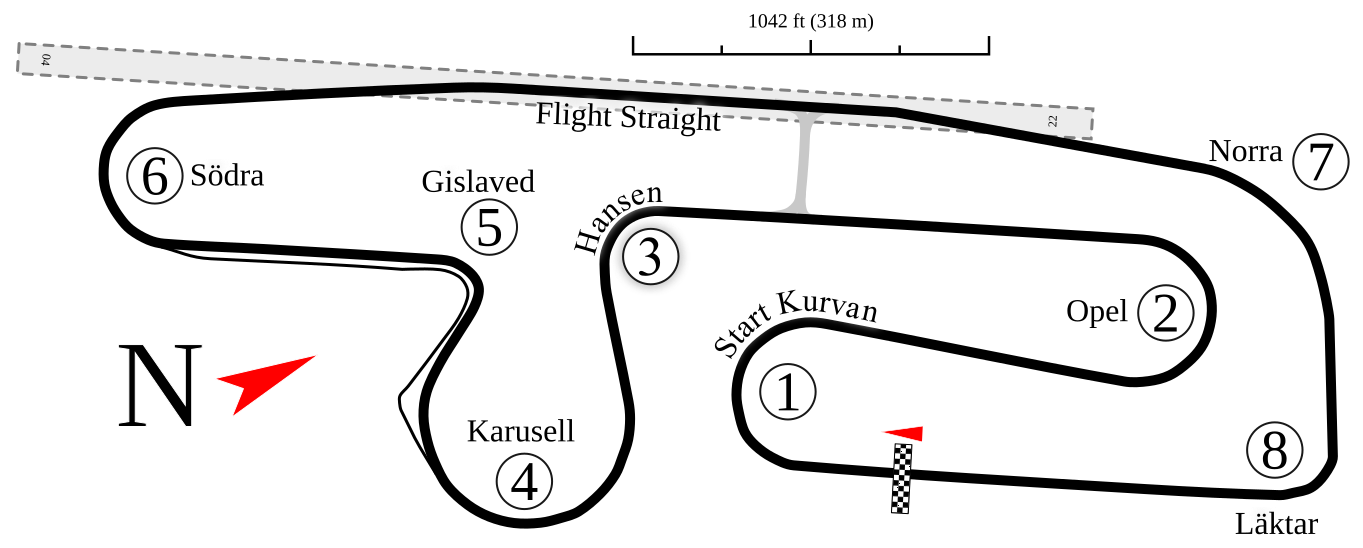 Anderstorp Layout
The first race was an international sportscar race in June 1968 and the Swedish GP was held six times between 1973 and 1978, coinciding with the peak of Swedish racing stars Ronnie Peterson and Gunnar Nilsson. In the inaugural Swedish GP, the local fans nearly got a dream race. They packed into the facility in droves to watch Peterson lead from pole position in his Lotus and he was never headed until, cruelly, fate intervened and a slow puncture in the closing stages allowed Denny Hulme to sweep by to victory in a McLaren. Sadly for the home crowd, Peterson and Nilsson never tasted victory in their home event and by 1979 both were dead; Peterson killed at Monza and Nilsson succumbing to cancer. With their deaths, corporate and public support for the Swedish GP dwindled and the race was quietly removed from the F1 calendar after 1978. The circuit was also noteworthy because it was the site of the first and only win of two unconventional F1 cars: the six-wheeled Tyrrell P34 car in 1976 and the infamous Brabham 'fan car' in 1978.
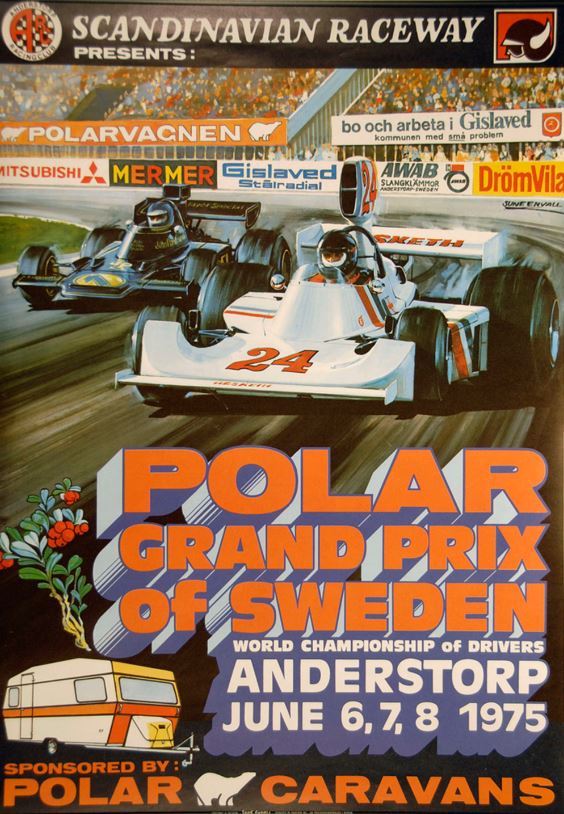 1975 Swedish GP Poster
Apart from F1, the track hosted the Swedish Motorcycle GP, the European Touring Car Championship, Superbike World Championships and FIA GT Championships. In 1993, the circuit held a 24-hour motorcycle race, but financial issues stemming from poor attendance led to the track's bankruptcy. International racing returned briefly to Anderstorp in 2007 but the Covid pandemic prevented further events planned for 2020. Since 2007, the circuit has maintained a domestic-based calendar and ongoing issues over noise complaints have led to the circuit's calendar being more restricted.
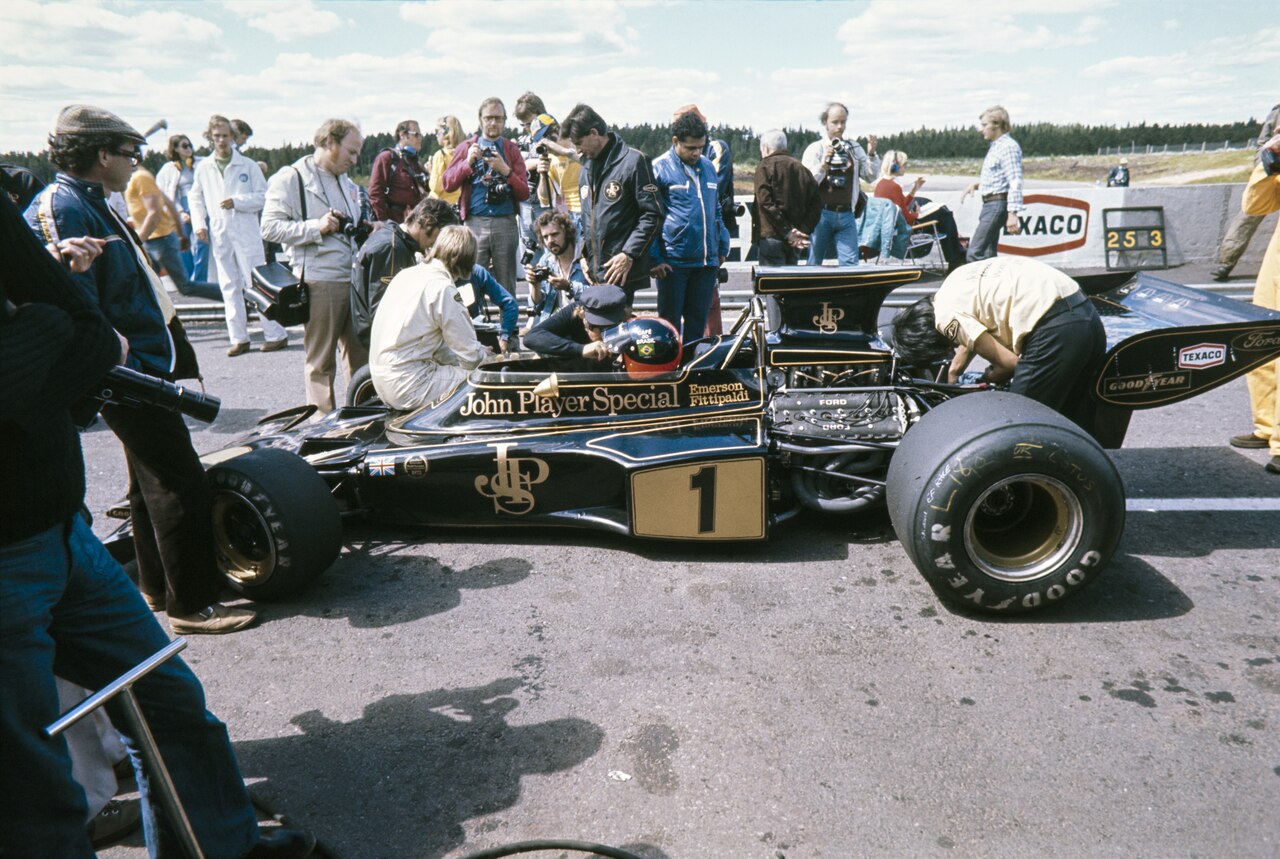 E.Fittipaldi 1973 Swedish GP (Photo; M.Lepola)
New Additions: January 2025
Welcome to the first update for 2025. I hope everyone had a safe and relaxing time during the festive break and I wish you all the best for the new year. Last year was a difficult year for everyone with all of cost of living challenges and I realise model cars were often the furtherest from our minds. There are signs that the worst may be over so maybe this year we can again enjoy our hobby of collecting model cars. Only a small number of models were received this month and as I'm seriously trying to reduce my inventory, you may have noticed the number of new arrivals have gotten a lot smaller. I am committed to stocking the models I have pre-ordered with my suppliers. The arrivals this month have a strong Japanese flavour and a couple of race cars are particularly noteworthy.
When most people think of 1960s sports car racing, the Ford GT40, Ferrari 330P, or the Porsche 917K come to mind. The Daihatsu Motor Company certainly doesn't figure when thinking about this era. The Japanese manufacturer is not very well known today after it was purchased by Toyota in 1967, but in 1966 when still an independent manufacturer, Daihatsu used their popular Compagno compact passenger car as the base for their front-engined P3 prototype. The Daihatsu P3 featured a 1.3-litre twin-cam straight-four engine and was capable of producing about 100hp. The P3 made its competitive debut at the Japanese Grand Prix at the Fuji Speedway in 1966, where it won its class. It was also entered in the 1000 km of Suzuka in the same year, where it failed to finish. The following year, it was run in the Suzuka 12 Hours; the No.6 car won its class, and finished fourth overall. The P3 was succeeded by the P5, which was more powerful than the P3. The Ebbro version represents the P3 (no.3) that did not finish the Japanese Grand Prix in 1966 and would be an excellent addition to any collection of 60's race cars .
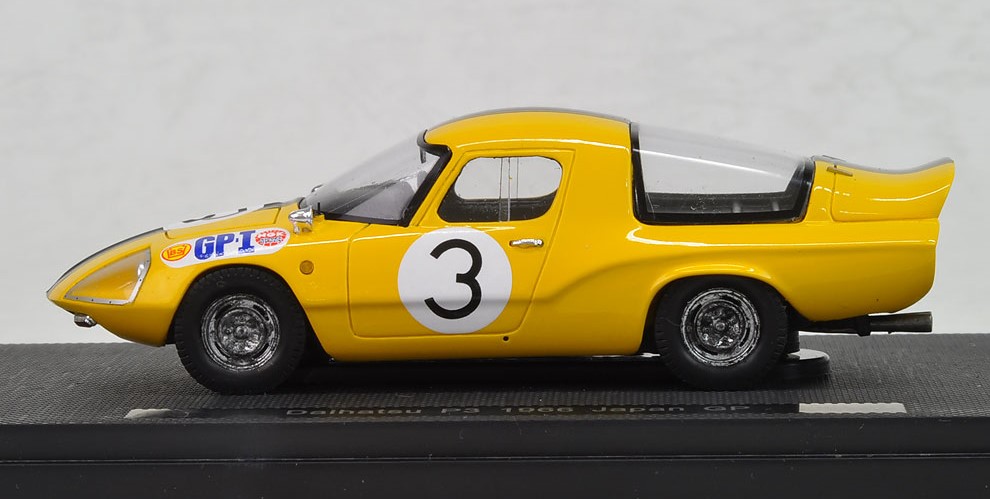 Ebbro: Daihatsu P3 1966 Japan GP (44367)
The 1966 Macransa Tojiro-III characterized post-war Japanese motorsport engineering; developed with ingenuity and perseverance in equal measure. Manufactured by Minoru Hayashi, who would later found the race car constructor Dome, the Macransa was based on the Honda S800, a lightweight roadster renowned for its 10,000 rpm twin-cam engine. Hayashi developed a FRP (Fibre-Reinforced-Plastic) monocoque to fit the S800 frame and to enhance performance, added a supercharger to the Honda engine. Domestic race cars built from the ground up were rare in the 1960’s, and most drivers with money imported exotic monsters like the Porsche 904. Against such opposition, the Macransa Tojiro-III debuted at the 1966 Japan Grand Prix, the country's premier motorsport event since 1963. However, an issue with the supercharger belt forced a retirement at its first race. The lessons Hayashi learned while developing the Macransa laid the foundation for Dome's future success, eventually becoming a leading Japanese race car constructor. Dome later offered Macransa kits to the public, allowing amateur builders to create their own S800-based race cars. Several of these vehicles continue to participate in vintage racing events today. The example modelled by Ebbro, which was driven by Rod Benders may have been one of these kit cars.
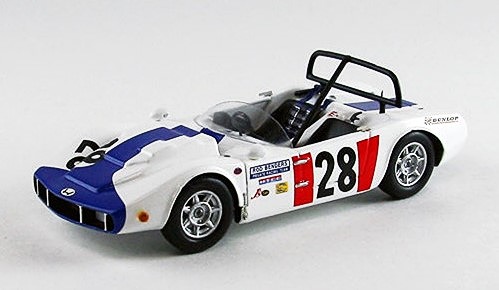 Ebbro: 1966 Macransa T-III (44641)
OK, that's it for my first update of the year. January is traditionally a quiet month with many on holidays but should you wish to enjoy the company of fellow collectors and vendors, then the first Sydney Toy and Hobby Fair is on the 3rd of January. Check out my Swap Meet link for upcoming events and dates for 2025. Happy New Year and until next month, happy collecting.
Le Mans / Sports Car Racing
- 1966 Daihatsu P3, H.Kukidome (3) Japan GP (Ebbro)
- 1966 Ford GT40 Mk ll, Miles/Hulme (1) 2nd Le Mans (CMR)
- Macransa T-iii, R.Bender (28) (Ebbro)
Road Cars
- 1958 Austin Healey Sprite Mk1 in red (Ebbro)
- 1938 Datsun 17 Sedan in blue (Ebbro)
- 1966 Nissan Prince Skyline 2000GT-B in red (Ebbro)
- 1989 Nissan Skyline GT-R (R32) in silver (Ebbro)
- 1995 Nissan Skyline GT-R (R33) in white (Ebbro)
- 2013 Nissan iDx Freeflow Concept in metallic beige/white (Ebbro)
- 1959 Wartburg 311 in blue (Maxichamps)
After Thoughts: "The Lear Vapordyne Steam-Powered Indycar ."
The Lear Vapordyne Indycar is one of the most fascinating and ambitious ventures in the history of motorsport. Despite its ultimate failure, the Vapordyne remains a prime example of unconventional thinking and innovation.
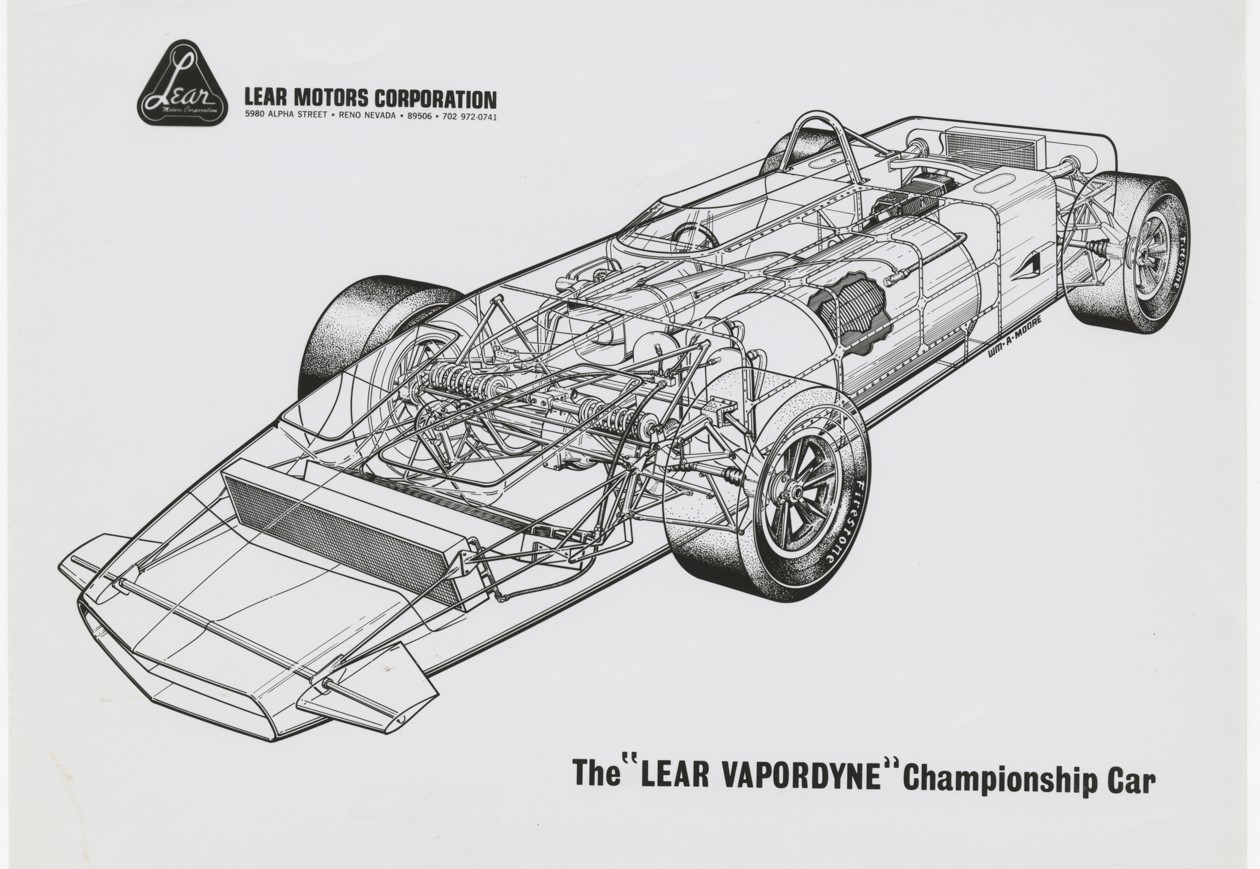 Tecnical drawing of the Lear Vapordyne
Bill Lear, famed inventor, entrepreneur and eccentric[1] best known for the Lear Jet, sought to revolutionise racing by introducing steam power to the Indianapolis 500. The concept was based on a compact, delta-configuration steam engine featuring six cylinders, 12 pistons, and three crankshafts arranged in a triangular layout. This design was unique in automotive engineering and emphasised torque over high-revving power. Lear envisioned the engine producing 1,000 hp or at least matching the 500-hp gasoline engines used by contemporary IndyCars. The car would have a six-foot-long boiler but despite its innovative design, the Vapordyne's engine would have struggled to produce 100 hp, far short of its ambitious target. To reach the desired power output, the boiler would have needed to be significantly larger—likely larger than the car itself.
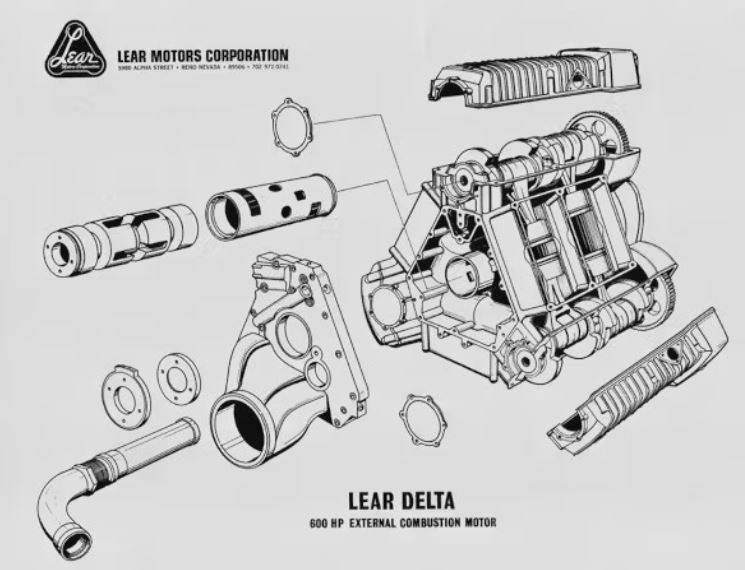 The Lear Delta Steam Engine
Lear partnered with Ken Wallis, who had a hand in the STP Turbine Car and the Shelby Turbine Car, to develop the Vapordyne chassis. Wallis convinced Lear to enter the Vapordyne in the 1969 Indy 500, giving them just 13 months to start and complete the project. The rolling chassis resembled the turbine cars of the era, with the boiler occupying the space next to the driver and the engine mounted behind. By early 1969, with the Indianapolis 500 approaching, neither the engine nor the boiler had been built, leaving only a rolling chassis as the tangible result of the project. Lear eventually dismissed Wallis after spending an estimated $4 million on the chassis alone and the project was abandoned. Lear had poured $350,000 per week into the project, with unconfirmed estimates placing total development costs at around $13 million—a staggering sum for an experimental car that never raced or tested on a track.
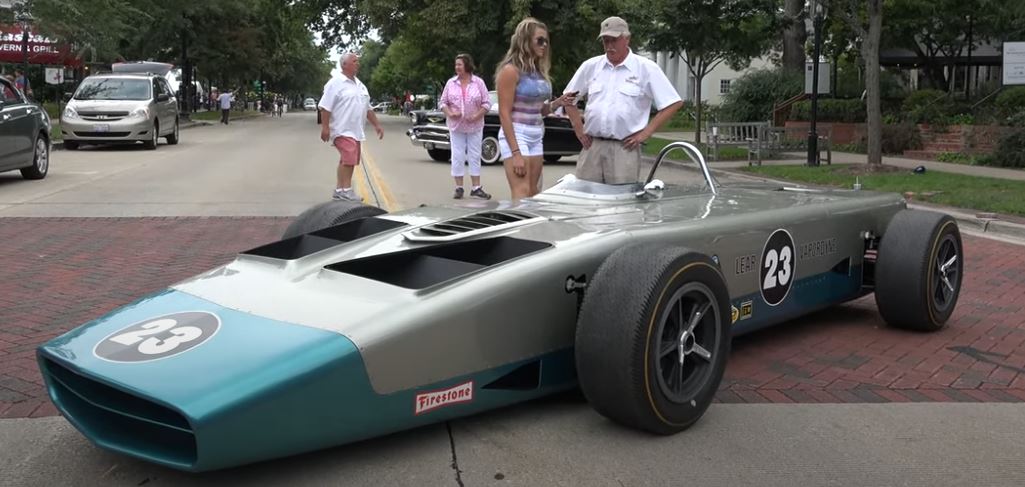 The Vapordyne Rolling Chassis
The Vapordyne still exists today and has been restored as a rolling chassis but there is no trace of Lear’s revolutionary steam engine. Probably only a mock-up ever existed. The Vapordyne wasn’t Lear’s only foray into steam power. He also developed a steam-powered bus in the 1970s, tested in California. While functional, it was deemed too inefficient, especially in the wake of the 1973 oil crisis.
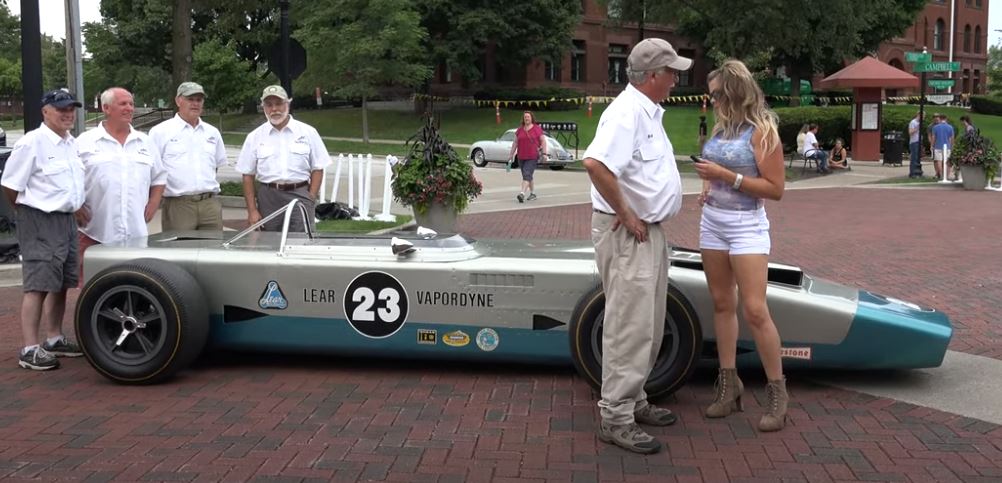 The Lear Vapordyne on display
Although Bill Lear was one of America’s most prolific inventors, earning over 120 patents, the Vapordyne was an over-ambitious project that ultimately became an expensive failure.
Note [1]: He named one of his daughters Shanda (as in chandelier).